

The fires of Saint Anthony
Known as Fòcara (from the Latin focus, meaning “fire”) in the Salento dialect of Southern Italy, the Fires of Saint Anthony in Novoli is a colossal bonfire lit annually in honor of Saint Anthony the Abbot, patron saint of animals. In this section of the Past Present Archive, we publish an ethnographic account originally documented in 1913 by scholar Francesco D’Elia for Apulia, a cultural and region-focused journal that ceased publication at the onset of World War I. Reaching up to 25 metres in height, the fòcara is described by D’Elia as a colossal woodpile, serving as a catalyst between the image of the Saint and a rich ritual that includes ceremonial gunshots, processions, communal gatherings and wine. The tradition’s core form remains alive and celebrated every year to this day. This is an adapted and abridged version of D’Elia’s original essay, whose detailed linguistic footnotes on the Salentine dialect have been omitted. For the full annotated text, refer to the Italian version.
In the Lecce dialect, Saint Anthony Abbot is called Sant’Antoni de lu fuecu – “Saint Anthony of the fire” – protector of fire and of pigs. Not to be confused with Saint Anthony of Padua, known instead as Sant’Antoni de le tridici razzie (“of the thirteen graces”), evidently because his feast falls on the 13th of June. Saint Anthony Abbot’s feast, by contrast, falls on the 17th of January, a day on which it is customary to bless cattle. In iconography, this Saint is depicted with a pig beside him, a long staff topped with a bell in one hand and a book with fire painted on it in the other. These symbols have the following popular explanation.
Before becoming an anchorite and devoting himself to a contemplative life, according to local legend Saint Anthony was a swineherd, a belief that certainly derives from seeing a pig painted in images of the Saint, and which would also explain the staff he carries. But how did the Hermit come to keep company with that rather unlikeable animal?
Depictions of the Saint predating the Giottesque period show a mouse instead of a pig, which signifies the solitude he experienced in the Thebaid, where Saint Anthony chose to live; the mouse must later have turned into a pig to signify the fire of lust: “the symbol of the solitude in which the venerable Abbot lived was replaced by that of his power over the burning passions of the flesh”.
The pig, then, is the tempting demon. But there is another, folk explanation, telling how the devil, in order to tempt the Saint, would appear to him in the form of various animals; he once appeared transformed into a pig, and Saint Anthony said to him: “Now you have taken on just the form that suits you best; so remain thus forever!” And the devil, without troubling him any further, remained a pig until the Saint’s death.
The bell on the staff is most likely a later addition, perhaps derived precisely from the belief that Saint Anthony had originally been a pig-keeper; and the bell would have served to call the animals. Let us now turn to the explanation of the fire, again according to popular belief.
It’s worth noting that this Saint’s patronage of fire may well be a continuation of the pagan cult of fire, with the Christian legend serving as a disguise for the myth of Prometheus. In some places, it is even said that Saint Anthony descended into Hell to steal fire and give it to mankind, before returning to the desert to meditate, thus echoing Prometheus, who after gifting men the fire stolen from heaven was chained in the harsh solitudes of the Caucasus.
Thus Saint Anthony is a pyrrhophóros (“fire-bearer”) like the ancient Titan, and his staff, which captures and holds fire, corresponds to the ferule (the Aryan pramantha) of the one who was chained to the Scythian cliff. This, I believe, is also where the name Sant’Antoni de lu fuecu comes from, given to the Saint in our province, as well as in other parts of southern Italy and in Sardinia.
The cult of fire is still visible today in the custom of lighting bonfires on the evening of the 17th of January, a rite widespread across southern Italy and Sardinia. In Lecce, the bonfire (dial. focura) is usually lit in the Piazza delle Alcantarine, though smaller flames are also lit at various other points around the city.
But the most distinctive bonfire held anywhere in this province takes place in Novoli, near Lecce. This town, of which Saint Anthony Abbot is the patron, thus deserves a special description, along with the customs observed there on the 16th and 17th of January.
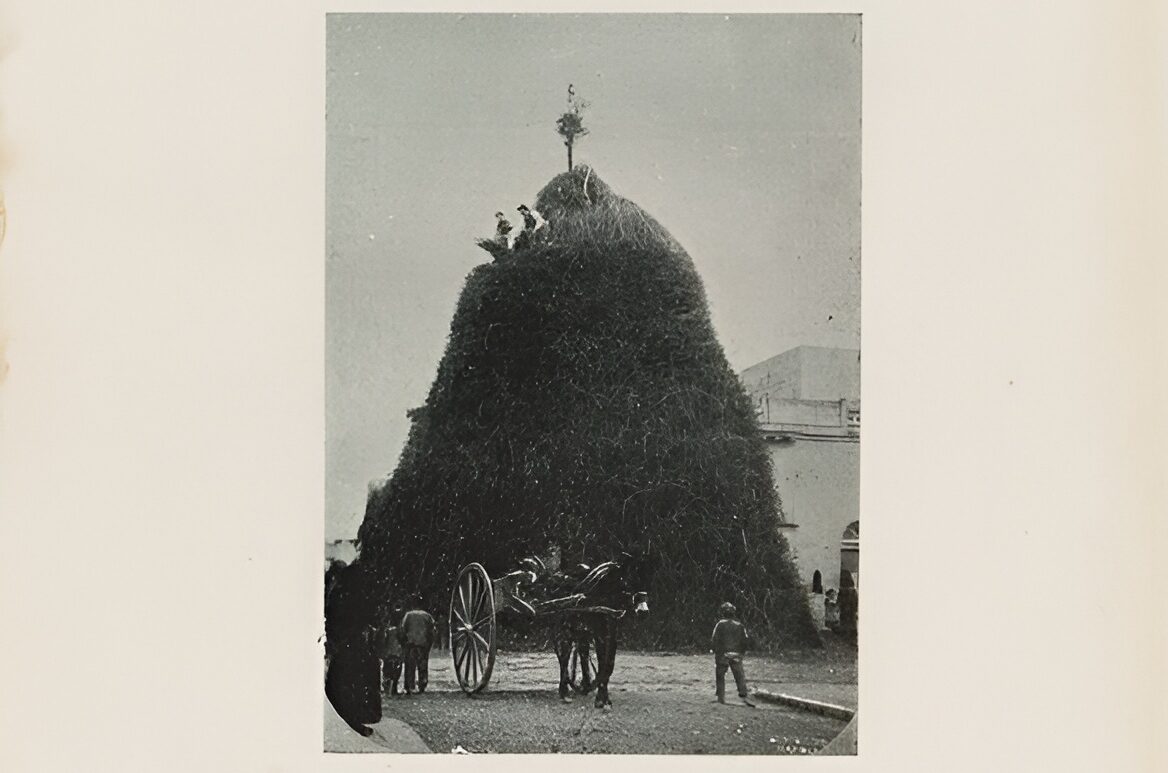
As early as the first days of December, wood is gathered from the countryside and piled up along the road and in the square named after Saint Anthony. Following an age-old rite, construction of the focura begins on the first day of the novena, so that it takes nine days to complete: it must be finished by noon on the eve of the feast. Its completion is announced by sharp gunshots, which draw the people to the square, where they see it, admire it, and pass judgment on it.
As can be seen in the accompanying photograph, taken and kindly provided to me by my friend Saverio D’Agostino of Novoli, the bonfire must be as tall as the church’s façade, with the flag that crowns it often reaching as high as the cross on the temple.
The colossal woodpile must be given the shape of a cone (dial. un pignu, “a pine”), at whose top an orange branch is fixed, bearing four or five hanging fruits. This is known as la marangia de papa Peppu [the orange of Father Peppu], because the branch is always cut from the garden of a local priest by that name. The oranges do not seem to carry any symbolic meaning. It is also customary to add wheat sheaves tied in a palm-leaf shape (perhaps a symbol of abundance), and finally a tricolour flag bearing an image of Saint Anthony, which, of course, will burn along with everything else!
On the afternoon of the 16th, a procession winds through the streets of the town, joined by all the local confraternities. The townspeople carry large candles weighing no less than ten pounds each, with some – known as sugghi on account of their bulk – weighing as much as fifty pounds. All this forms the intorciata, in which several hundred kilograms of wax can be seen, to the townspeople’s evident satisfaction.
When the Saint’s statue leaves the church, people begin offering votive gifts: gold objects, especially watches, are hung on the golden “fire” the image carries. So many can be seen hanging there that the Saint has earned the nickname tirluciaru, “watchmaker”. Once the procession has withdrawn and the fireworks have been set off, the focura is lit to the sound of the royal march, an honour reserved for the chief steward of the feast.
Meanwhile, the bonfire burns brightly all night, admired by much of the townspeople. After generous libations, especially with the ritual moscato wine, people spend the night chatting, joking, and singing. The living fire lasts three days: once the sarmente (tree branches) burn away, the thick logs at the base of the pile, known as rape, catch fire in turn. Everyone vies to take home a little of that sacred fire out of devotion, while the ashes are sold as relics.
On the 17th, there is a great gathering of outsiders who have made a vow and who make their way to Novoli almost entirely on foot. They carry large candles for the second intorciata, which is formed by them alone. This intorciata covers only the stretch that goes from the Saint’s church to the local parish. The extremely loud fireworks display, called strascina [literally “the dragging one”] for its long duration, with several hundred lire [the Italian currency of the time] lavished on it, is lit a quarter of an hour before the procession sets out and must be over once it has reached the parish church.
On this day of such solemn celebration, by ancient custom, nu sse ncammera [literally “one does not indulge/feast on rich food”], that is, no fatty foods, meat, or dairy are eaten; and it is instead traditional to have gnocchi with fish, which arrives in abundance from the nearby coast. The local moscato wine is also traditional, and is sold at a high price for the occasion.
Footnotes & references
From Apulia. rivista di archeologia, filologia, storia e arte della regione, Vol. 3, Martina France: Apulia, 1912. Available in Italian at the Internet Culturale website (pp. 66-69) [last access 2 September 2026]
____
Further Reading:
Spagnolo, G. (2025) Novoli e il culto di sant’antonio abate: Le Origini e La Focara. Fondazione Terra D’Otranto. Available at (Italian): https://www.fondazioneterradotranto.it/2025/01/12/novoli-e-il-culto-di-santantonio-abate-le-origini-e-la-focara/ (Accessed: 03 September 2026).
____
Cover image: the fòcara, by Saverio D’Agostino, (ca. 1912), first appeared in Apulia. rivista di archeologia, filologia, storia e arte della regione, Vol. 3, Martina France: Apulia, 1912.
Recent articles
Walking through places generates mental images we carry with us: glimpses of where we were and what we did. But can we be sure of that? Think of the image you carry of a place you’ve walked: its colours, how it unfolded, its texture, its sound. Always slipping, always being… Read more »
Unfolding through the city of Guimarães, Portugal, The Walking Body is an artistic research programme that explores collective walking as a methodology for situated knowledge, creative inquiry and engagement with place. Taking place across three consecutive editions (2024–2026), the programme has generated a range of artistic outputs: from drawings to… Read more »
At some point in the early twentieth century, during one of her many travels to Scotland, Vernon Lee (the pen name of Violet Paget) visited the shores of Fife, then one of the country’s most heavily industrialised regions. Driven primarily by coal extraction and linoleum manufacturing, Fife’s industrial expansion left… Read more »