


The Poetics of the walking images
Visual images are uncovering the poetics of reality. In a way, they are worth existing if they can interpret reality in a poetic way. One can name numerous of these approaches in the process of the visual arts. In the realm of images, the history of Art (a mega-concept) can be seen as a succession of visual poetic texts.
Spanning a 20-year process (since 2007) Visual March to Prespes, can also be seen as a series of poetic images of walking practices. Over the years, Visual March to Prespes has been encountering people and entities, shaping a nomadic walking body that keeps expanding. In our very first Marches (2007 το 2010), the photographers uncovered the concept of shifting landscapes.
The Land Art Encounters from New Mexico of the following decade connected us with the rough landscapes of migration in the borderline between Mexico and the United States. The Balkan artists and theoreticians who joined in 2016 revealed the complexities of the Balkan heartland— and again, the international community of Interartive magazine, the WAC Encounters, the WALC partners and nodes, and all the creative persons and collectives that we encountered over time. They all have contributed to the way Visual March to Prespes perceives realities. We are grateful to all those walking comrades.
This text is as much a reflection on how walking and visual perception intertwine as a tribute to them. We walked with them for years either mentally or physically crossing landscapes in places like Grammos, Arizona, Pyrenees, in Lahore, Dendropotamos, Brooklyn, Sarajevo, Lebanon, and in so many lands all over the world; the sensorial landscape is transformed into an immersive succession of embodied experiences.
In walking art and practices, image is not stable; it is a crack in time and place. Walking images are not objectified moments that can be seen exhibited in museums, gallery spaces, or movie theaters. Even the most advanced technologies cannot solidify their actualities. They are memories slipping in time, vanishing in the infinite of spaces, thoughts, ideas. The poetics of walking images are not there to be experienced; they exist in the bodies of those who have momentarily grasped them and in the minds of those who are listening to the narration of the walking experiences or the fragmented recordings, whether optical or audio.
The walking poetics cannot be revealed in objectified images. Images can function only as the post-its of the embodied experiences. The initial recording is no more than an initial sensorial stimulus (visual, audio, tactile, olfactory, gustatory) and functions as a scrappy trace of an experience.
The artistic practice that will be implemented in the visual remnants of some of the walking processes of Visual March to Prespes is that of a return to a state of understanding. A photo is not a photo e.g. a fixed image of a reality. It is a crack in the vagueness of memory. The walking artist is not a creator of an objectified image (such as painting, sculpture, video, performance) that derived from a recorded impression during his walks. He is an interpreter of the fragmented traces of memory.
From the infinite images that have been part of the Invisible Library of Experiences of Visual March to Prespes, six images and one tale are selected, and here they are with a visual and a wording reaction.
______
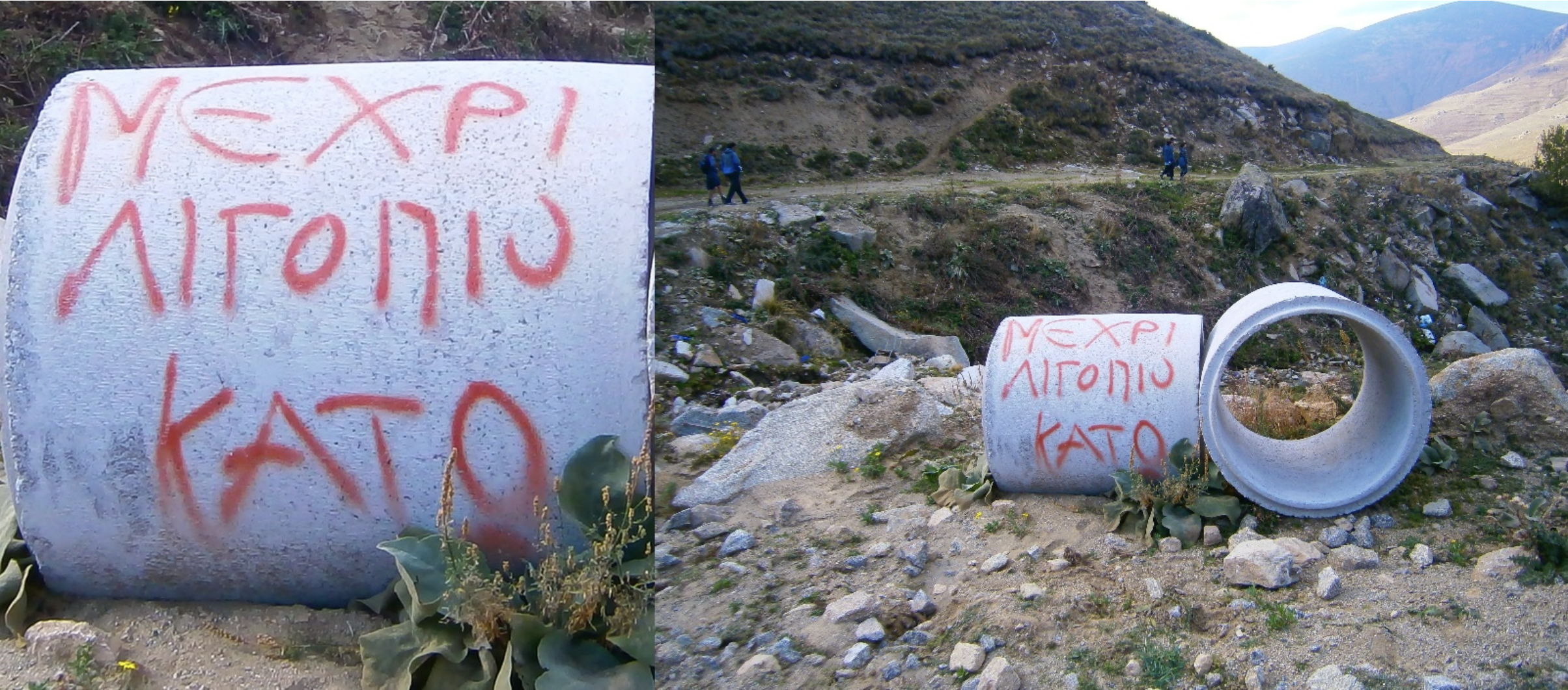
The Oryza cylinder
We walked in 2012 toward the peak of Varnous Mountain, Oryza. It was an exhaustive process, till the 2334 meters of the peak. The view offered a broad vista of the plain of Pelagonia, the surrounding mountains, and the basin of Prespes mountains.
During our descent to 2000 meters, we encountered two highway-culvert tubes. I did not pay any attention to them, I didn’t remember having seen them; Years later, upon going through the photos that were taken that day I say that one of our colleagues, Eleni Niska, had taken a photo of the cylinders, one of them with graffiti on it. For her it was an important encounter.
In the crest of the mountain Oryza, what can a graffiti of “Until a little further down” mean?
To whom is “Μέχρι λίγο πιο κάτω” addressed? And what is the “little further down” of the 2000 meters? The 1900 meters? The 1800 meters? The 1700 meters? The 1600 meters?
Who is the author of that urge?
A few years later I returned to see the cylinders again. Nothing was there; the landscape had absorbed the object and my memory.
______
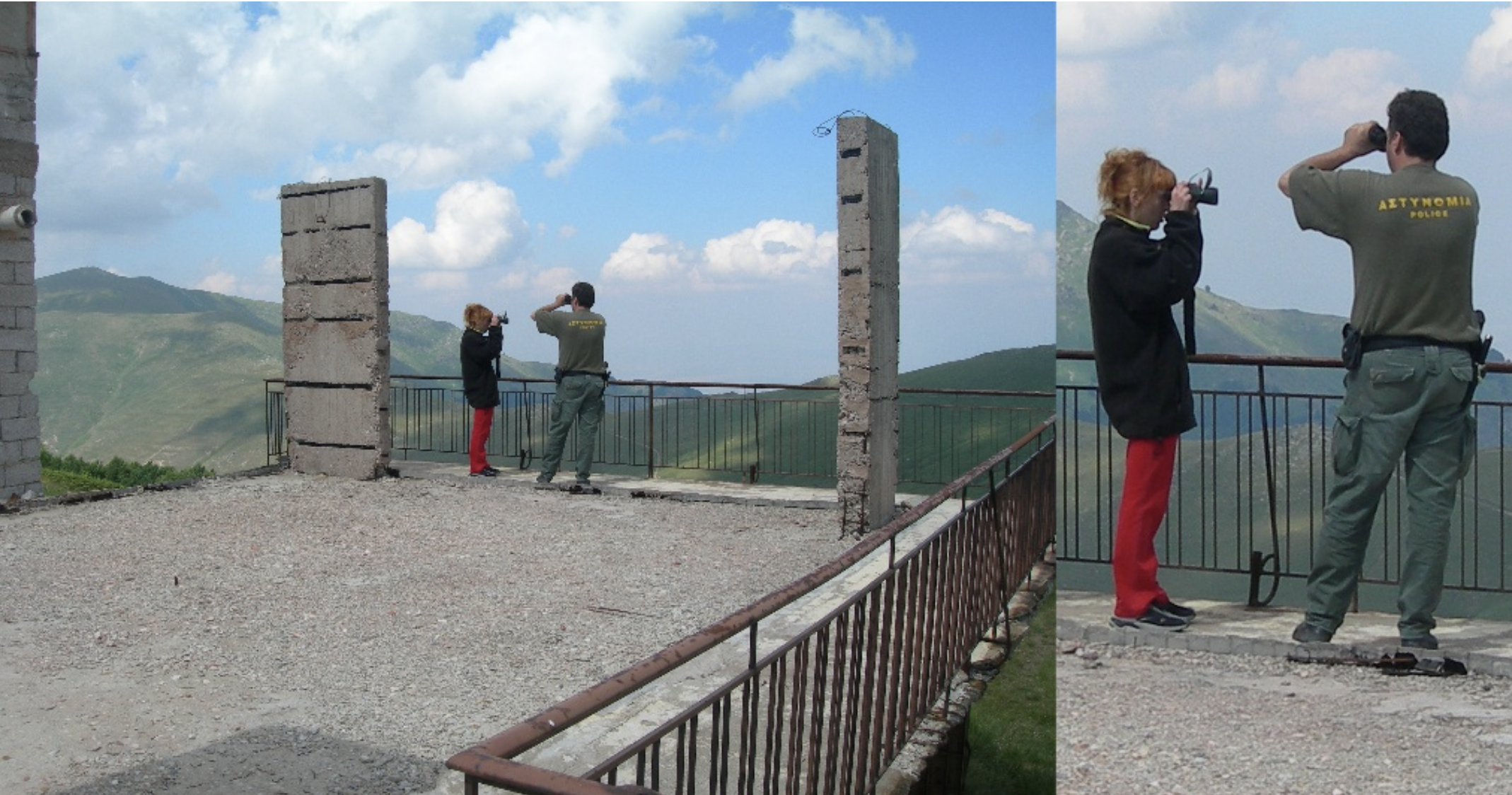
Observatory
I took the photo on the afternoon of Thursday, June 27th, 2007. It was my first ascent in the mountains of Florina, and I still recall the excitement of that day. It was not just any day: it was the First Day of my new life. The First Day of Visual March to Prespa.
The photos that were taken then were the outcome of that euphoria: everything around me was new. The mountains, the senses, the people, the animals, the discussions. I am not a photographer, not even an amateur one. Thursday, June 27th, 2007, was when I discovered the significance of recording, the importance of understanding the moment.
In one of the photos, I depicted two observers. On the left, there is Anastasia Notta, an art student from our nomadic body; on the right, a border patrol officer. We found the patrol officer there, as if he was waiting for us; he was not part of our nomadic body. He stayed with us for some hours and then he left. Nothing was connecting them: the clothing, the posture, the sex, the tool of observation (one is holding a camera, the other binoculars) they are all different. The one is carrying a gun, the second nothing but herself.
Years later, the persistence of their observation became the focus of my reflection.
Watching whom? Watching what? What is this unexpected pair trying to find, or uncover?
From what enemy are this woman and the police officer trying to protect themselves? What are they trying to prevent?
Or is it not that?
______
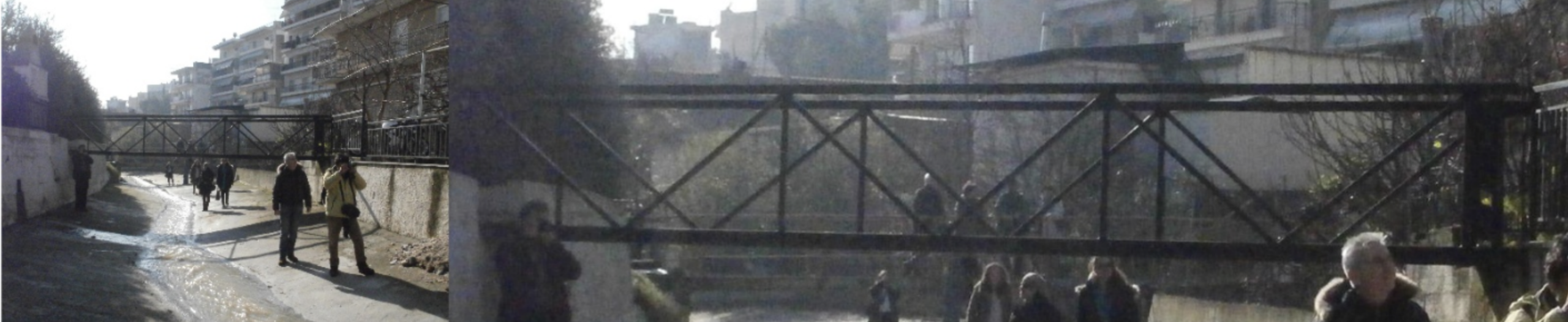
Impossible Bridges
After years of walking in the mountains, 2014 was the first of my walkshops that took place in a city. We walked along and inside Dendropotamos, a river that defines the western border of Thessaloniki. It is not a long river, no more than 10 kilometers. It crosses the most degraded part of the city.
People had to improvise building bridges that connect to two shores. The area, forgotten for years by any central authority, was structured from the need of the people to survive. These passages (more than ten) are not made from central planning or the knowledge of an engineer; The bridges are made from the need to cross, with whatever was available.
Who is crossing? What? Is the nomadic body a river flowing under a bridge?
Or is the bridging of two shores of the realities that the nomadic body tries to escape from?
And the water? Where is the water?
______
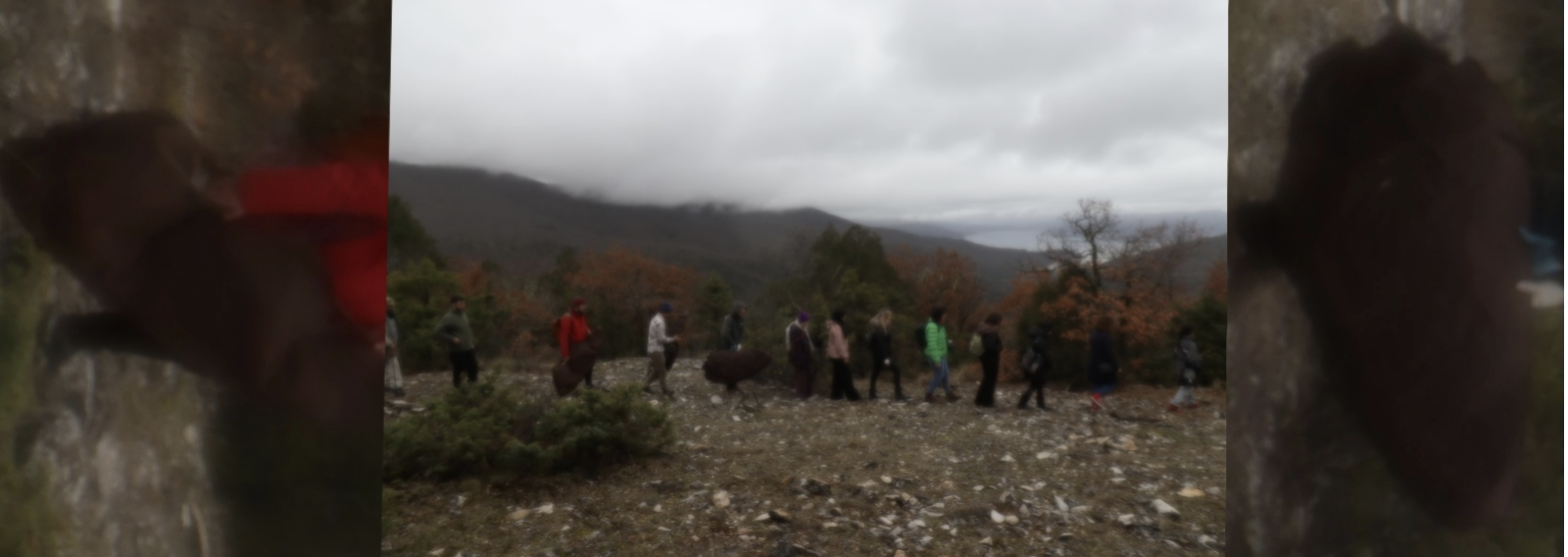
Napalm
In 1949, during the last year of the Greek Civil War, a new weapon was tested for the first time: the Napalm bombs. Hundreds of soldiers of the Democratic Army were evaporated in the horrible flames of that weapon thrown to the slopes and peaks of Western Macedonia from the Curtiss SB2C-5 Helldiver, the main type of aircraft of the Greek Army, under the guidance of the American military counselors.
On Saturday, March 2nd, 2024, seventy-five years later, a group of graduate students of the Department of Fine Arts of the University of Western Macedonia encountered the shell of a civil war napalm bomb in the abandoned camp of Hagia Varvara. A nomadic body of young artists, most of them born half a century after the end of Civil War, encounter the ultimate relic of horror.
What shall we do with that relic? Shall we leave it there in its place shall, or shall we take it in a “protected” space? And if the smugglers of contemporary archaeology remove it, to sell it in a collection in Athens? We decided to remove it, and with a walking procession we took it down to a place where we will take care of it.
What are these young people carrying?
What are the scraps of metal that they hold in this misty atmosphere?
What is their value?
How expensive are these scraps in the markets of ideas?
______
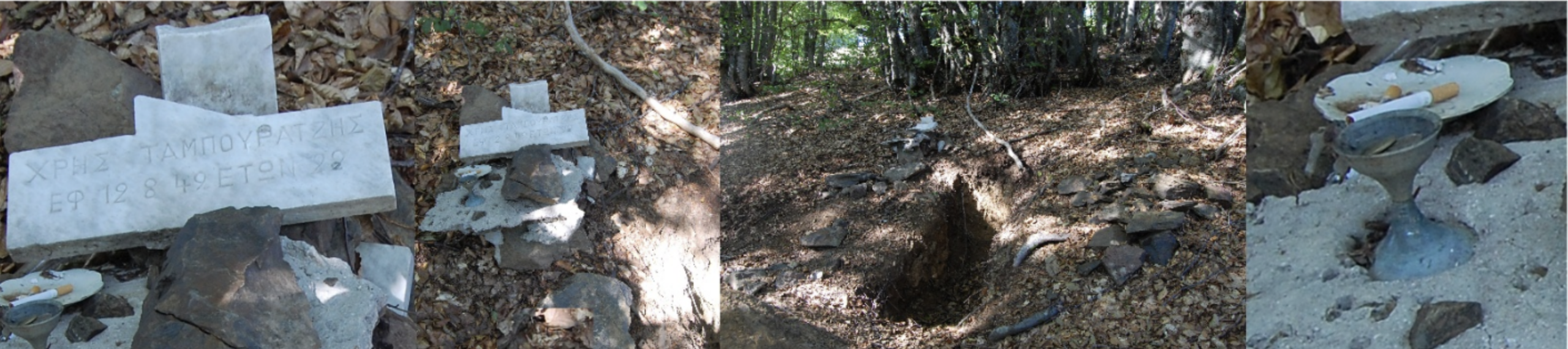
Ταμπουρατζής
The name of the soldier is Χρήστος Ταμπουρατζής (Christos Tabouratzis). Χρήστος was killed on August 12th, 1949, the last day of the war. He was 22 years old. Nothing is known about him. Basically, he is an anonymous person with a name.
The grave is in Lesits, a 2.124 meters peak of the mountain Verno, where the last major battle of the Greek Civil war took place. Usually, the bodies of those who fell on the battlefield were carried in one of the neighboring cities and were buried in the military cemeteries. Tabouratzis is the only one, from what I know, that was buried on the spot where he fell, and a grave was made. Some years later, the body was exhumed, but the fragments of the grave are still there.
The people who are passing by are leaving coins in the censer of his grave and their cigarette buts. Euros, Greek drachmas, Albanian leks, and even some coins from an Arab country can be seen there.
Why was he buried in Lesits? Why is the grave empty now?
And the body? Where is the body?
______
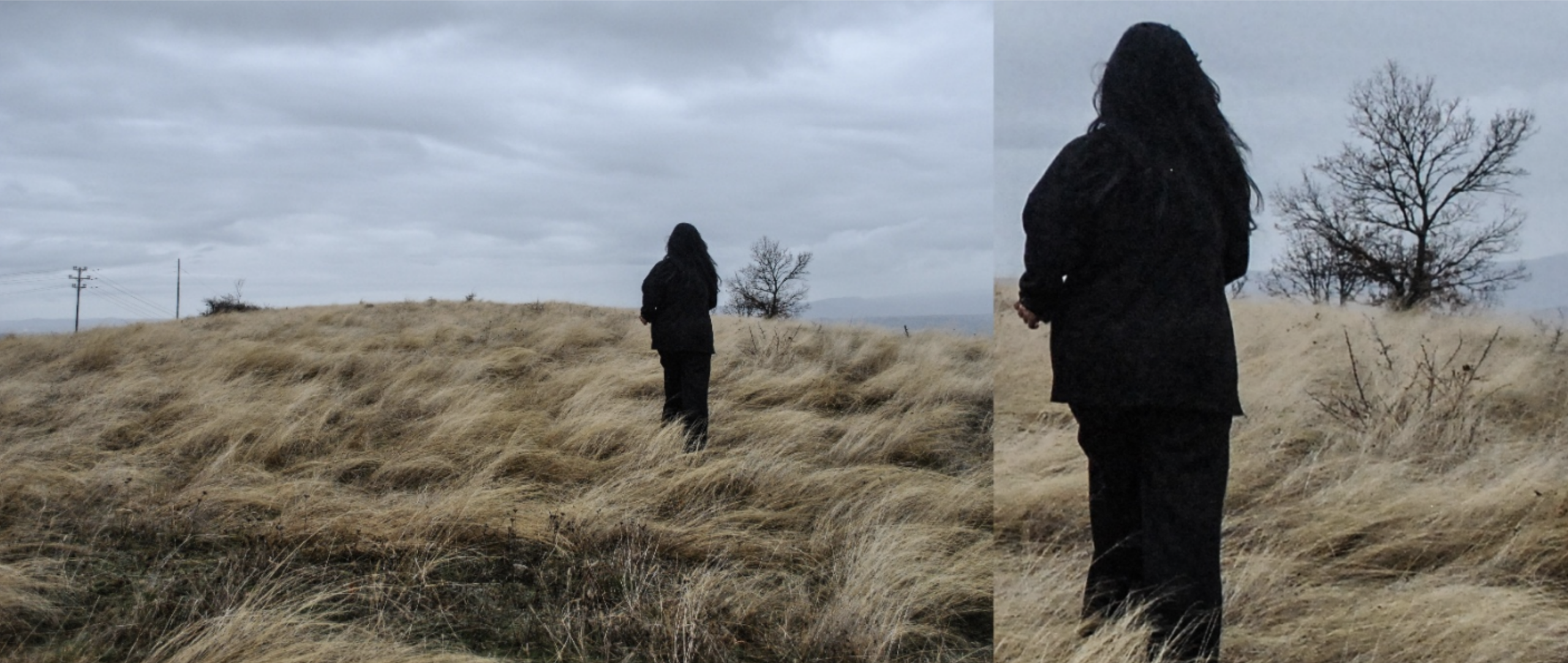
Gazing
One more Friedrichean back?
Or not?
Vrisi Nitsa: the wheat field and the withered tree.
Or not?
Footnotes & references
Titles of photos
1. Visual March to Prespes 2012, Walking in Oryza, Until a little further down, photo: Eleni Niska
2. Visual March to Prespes 2007, Walking to Pineritsa, photo: Yannis Ziogas
3. Visual March to Prespes 2014, Walking to Dendropotamos, photo: Christina Ploutoglou
4. Visual March to Prespes 2024, Carrying the remains, photo: Yannis Ziogas
5. Visual March to Prespes 2015, The tomb of Χρήστος Ταμπουρατζής in Lesits, photo: Yannis Ziogas
6. Visual March to Prespes 2024, Landscape in Vrisi Nitsa, Photo: Athina Gardani
Recent articles
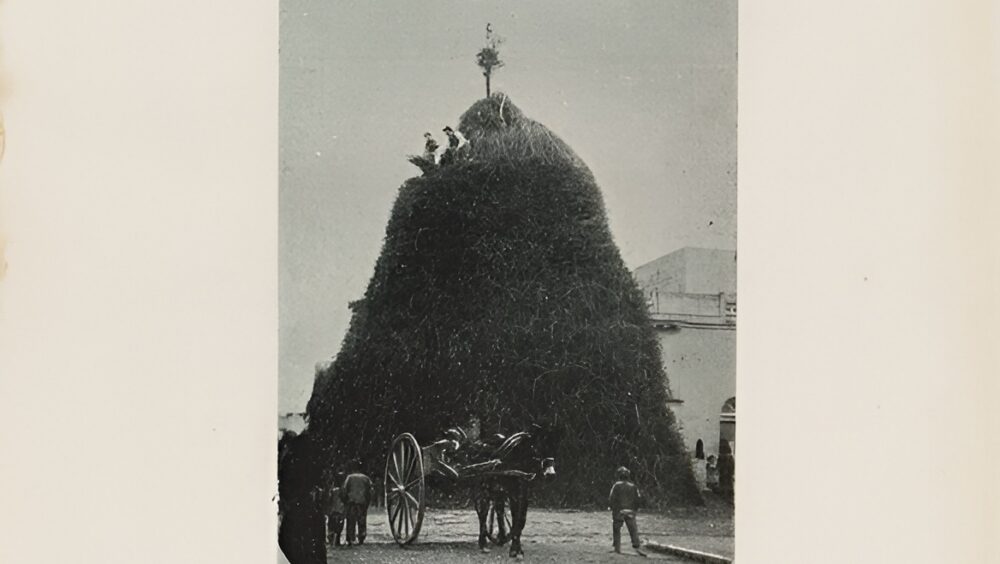
Known as Fòcara (from the Latin focus, meaning “fire”) in the Salento dialect of Southern Italy, the Fires of Saint Anthony in Novoli is a colossal bonfire lit annually in honor of Saint Anthony the Abbot, patron saint of animals. In this section of the Past Present Archive, we publish… Read more »
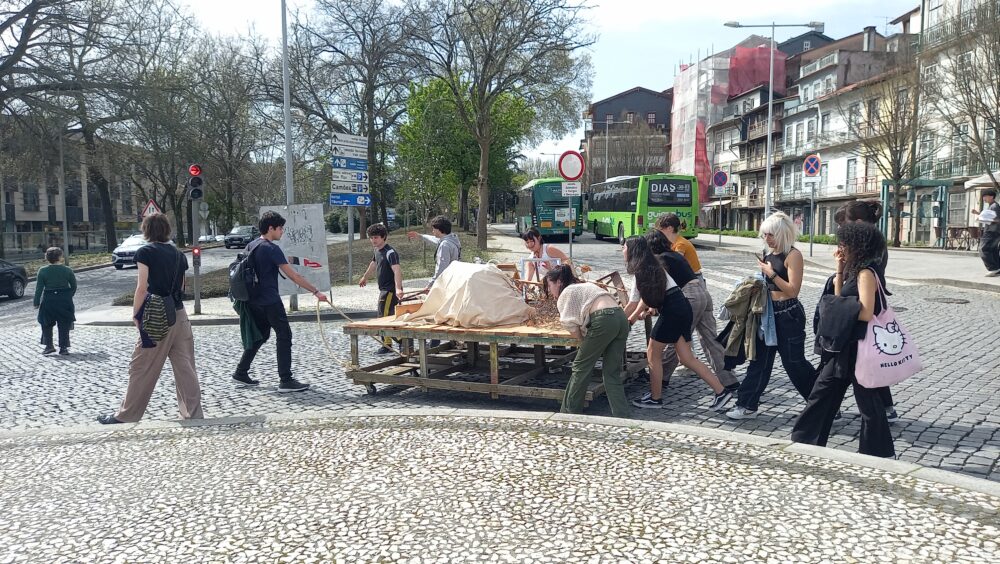
Unfolding through the city of Guimarães, Portugal, The Walking Body is an artistic research programme that explores collective walking as a methodology for situated knowledge, creative inquiry and engagement with place. Taking place across three consecutive editions (2024–2026), the programme has generated a range of artistic outputs: from drawings to… Read more »