

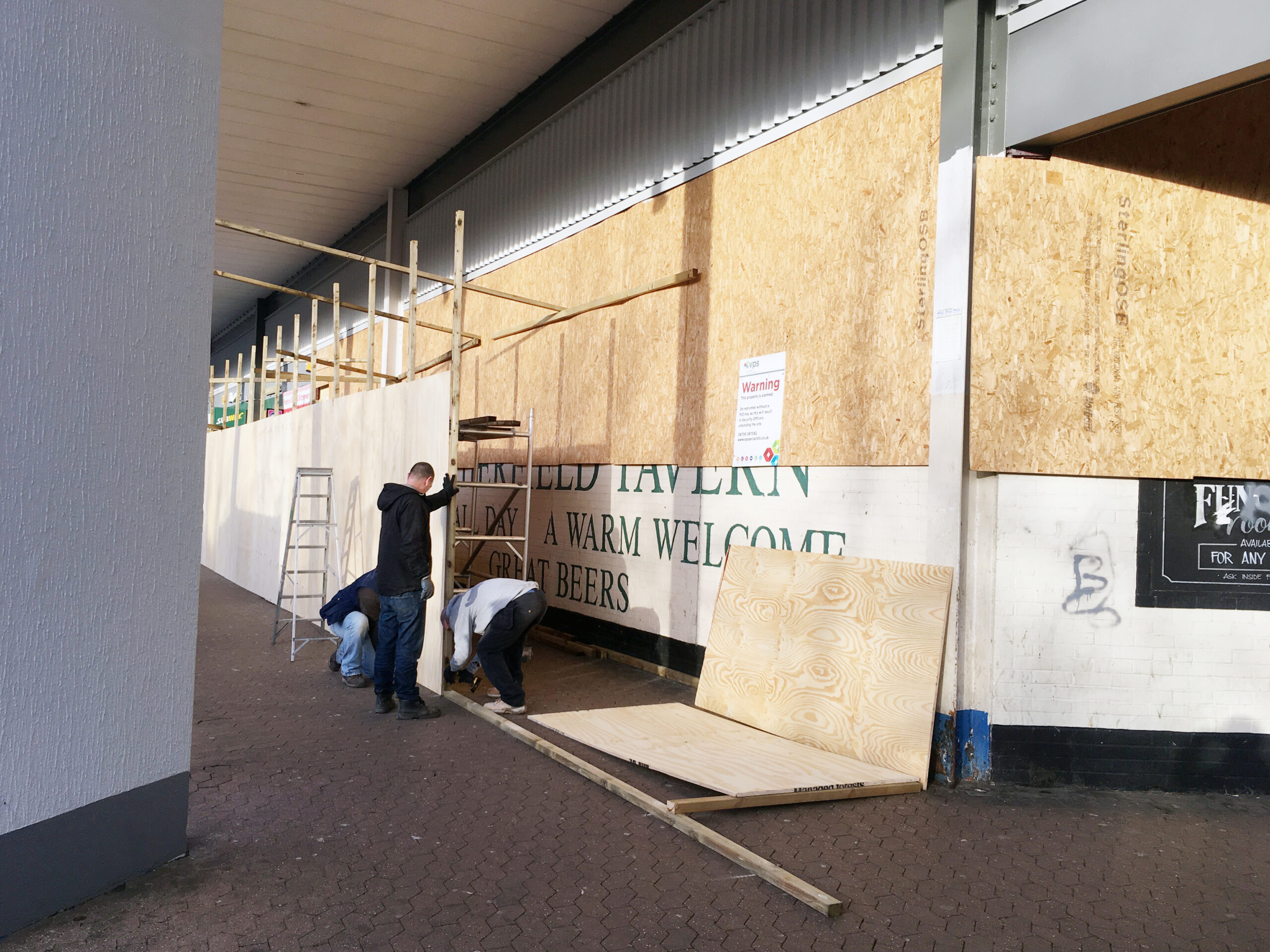
Milton Keynes in Ruins
Cities designed to make life easier, healthier and, ultimately, more efficient. In this psychogeographical reconnaissance, a former resident of Milton Keynes moves between her past and present in England’s best-known ‘new town’. Her walk is rawly erratic and critically inquiring at once, turning the city into a series of sites of affect, where personal memories prompt reflections on rational urban planning and the promises it may have left out.
Built to a 1967 master plan by its own Development Corporation, Milton Keynes, among the last of England’s post-war new towns, was meant to combine functionalist design, modernist utopian dreams and community-development initiatives, in a vision entangled with the political and economic ideologies of its age.
Milton Keynes was also my childhood home from the age of four. Its status as a new town grew up with me, forming an inescapable matrix in the fabric of place. Permeable boundaries: new life always flowing in, growth always spilling out. Thresholds, and raw edges. Materially crisp, sharp marble. Visions of shining, potent modernity.
I left at eighteen and returned years later, pregnant with twins and seeking refuge. The town had changed, and I found myself homeless in a place that, only decades earlier, had advertised for people to take up occupancy.
What am I left with today? Possibly a fault line: memories of a city that was promised as an ideal machine for living, set against experiences that never quite added up. And it stays with me, erupting in flashes as I re-encounter sites where my sense of belonging is made and undone, again and again.
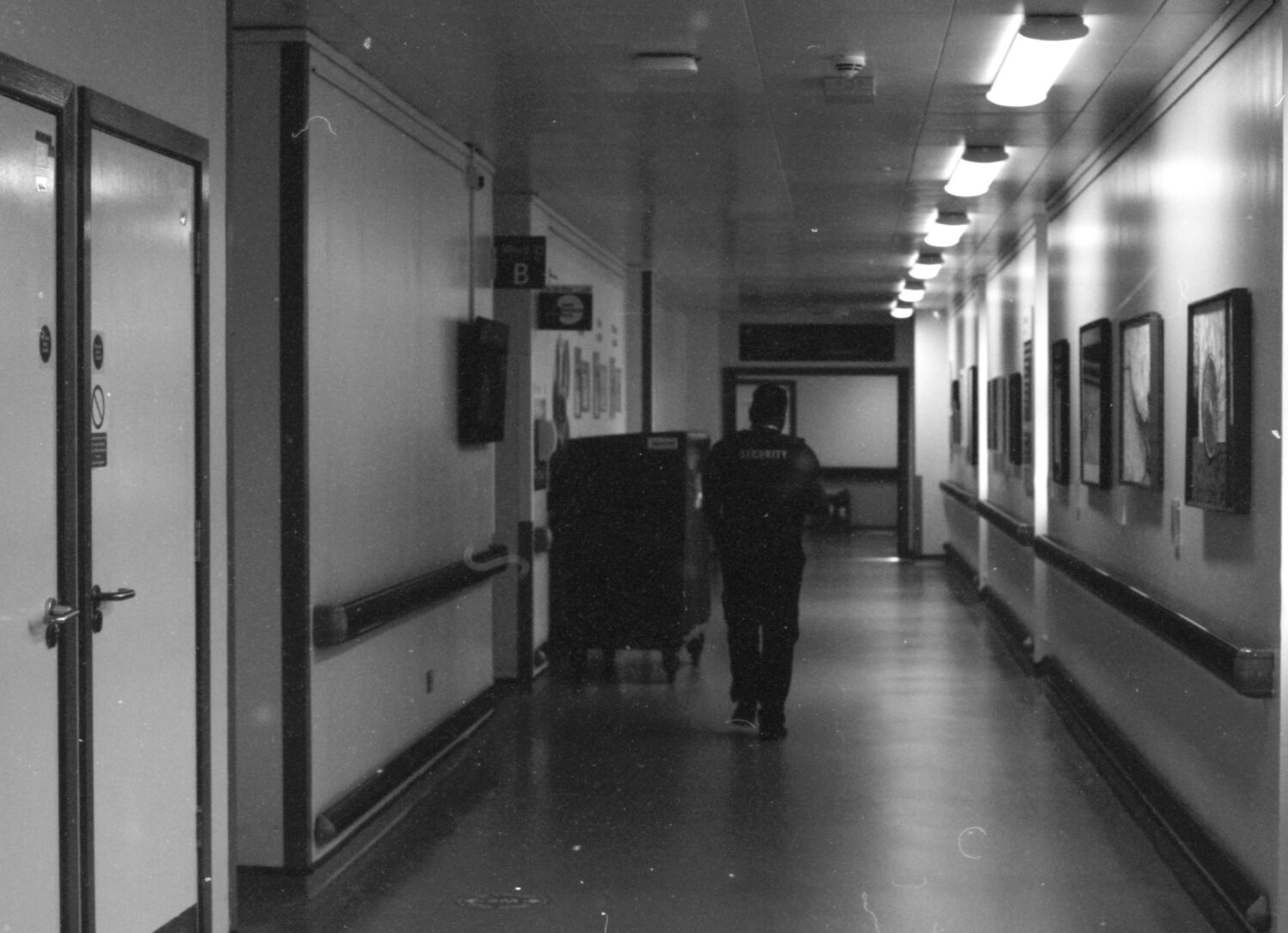
The Hospital
Something which was closer to me than is possible. Inside of me, connected to me, part of me, breathing me. Us. I remember a scan late on, a specialist one to look at your hearts, hearts inside chests, inside me. It never felt real: that was all I said all pregnancy. I just trusted the information about what was happening inside me, the same as when you are a kid and the teacher tells you about your organs. You hold your hand on your chest and feel your heartbeat and tell yourself that is proof enough of these obscure explanations.1
Then, I am separated from you by a plastic box. A plastic box replicating me. Physically me. Virtually me. Before that night I had never experienced claustrophobia. But then, that corridor: in my memory it was so long, so far to travel. The first time, I must have been in a wheelchair. I don’t remember any pain. Back here now, this corridor is so short: only 10 steps. This is how time works. The difference in stakes is what dictates the duration. Linear measurements are irrelevant.2
I laughed 12 years later, in a PTSD therapy session, the first time I was able to name the experience of the walls closing in. My fingers clung to the wooden handles of the chair while I watched the room shrink. Milton Keynes Hospital: among the 10 worst maternity service in the UK, 2013.3 I read that online when I was trying to figure out the complaint procedure, or whether a complaint would help. But what helps, if you don’t understand what is wrong or why?
In the end they survived. They didn’t die. I should be fine. I remember thinking that if I could learn to tell the story enough, I could qualify it somehow. I learned quickly to tell it and feel nothing, and thought this was progress. Progress is all that matters, right? But stories can help.4 To re-experience things. You can make things happen again, safely. Burdens. Associations. Connections: networks can paralyse you and networks can free you. I experienced it as an intensity. It was like a computer crashing, too much trying to load, a shutdown and reboot in safe mode.
It was in the NICU. It was the second visit. You were in different rooms, separated. One in intensive care, in the box, and the other in an open bed with a C-PAP machine squashing your face. You had gotten worse, while I was not there. That was the breaking point. The battering about on the waves, between safety and danger, between connection and severance. The overload, accompanied by a clear image. I had never seen a sensation before. Is that a hallucination?
I saw shutters, all around me, but peripherally, in the space between me and not me – an imaginary border, so suddenly and dramatically pulled into perception and destroyed at once. Am I me or this thing, or both? When they leave my body do they stop being me? In that shut-down, a secure boundary became the only possibility. The intensity of closure, of certainty, of protective reduction: the security of protective metal rigidity. A hospital built out of corrugated metal sheets. Once just an object on a map of a life; now its ridges intersect with my surroundings. Enclosed in a box. A box enclosed in me.6
[1] Body: It is early on in life that relating to bodies becomes a matter of separation: what is internal, and what is external. Pedagogical and cultural influences begin, from our earliest moment of receptivity, to build hegemonic notions: emotion as individual, and body as separate from the world around it. It was only during my pregnancy of identical twins that my acquired assumptions about clear cut boundaries of the body became untenable.
[2] – And memory: “Memory is not a faculty that operates on the basis of representation, nor is it an effect of repetition. Memory is instead linked to the differential structure of time itself, to the way time is actualized in each new moment, and to how difference is produced. Memory cannot be understood as a simple recollection of images but must be considered in terms of the forces that constitute its formation, which are always open to transformation and change.” (Deleuze, 1994)
[3] – “Between 2013 and 2014 five postnatal deaths occurred at the hospital maternity unit. Most involved staff allegedly failing to act upon warning signs of foetal distress.” (Milton Keynes Citizen, 2016).
[4] – “Change is the universal aspect of all these sources of story. Story is something moving, something happening, something or somebody changing.” (Le Guin, 2024)
[5] – For Brian Massumi, affect is not contained within the body because “there is no inside for it to be in, because the body is radically open”. It moves through and between bodies and, I am suggesting, place. Referring to an experiment on skin stimulation — where subjects only perceived a stimulus if it lasted more than half a second — Massumi writes: “…the half-second is missed not because it is empty, but because it is overfull, in excess of the actually performed action and of its ascribed meaning. Will and consciousness are subtractive. They are limitative, derived functions which reduce a complexity too rich to be functionally expressed” (Massumi,1995). The suggestion that what is experienced as lack of choice may be an overabundance of potential limited by processes of consciousness is revolutionary.
[6] – In a society where affect is individualised into ‘private emotions’, experiences of traumatic events are turned inwards and depoliticised, producing a disempowering paralysis. This mirrors the wider stuckness of the contemporary political conjuncture — what Mark Fisher calls ‘Capitalist Realism’. When a society’s common sense (in the Gramscian sense of what feels natural and obvious) is one of privatised trauma, agency — and even the possibility of imagining alternatives — is removed. In the aftermath of traumatic events, it is easier to imagine death than change. and to borrow Fisher’s own borrowed phrase: “It is easier to imagine the end of the world than the end of capitalism.” (Fisher2009)
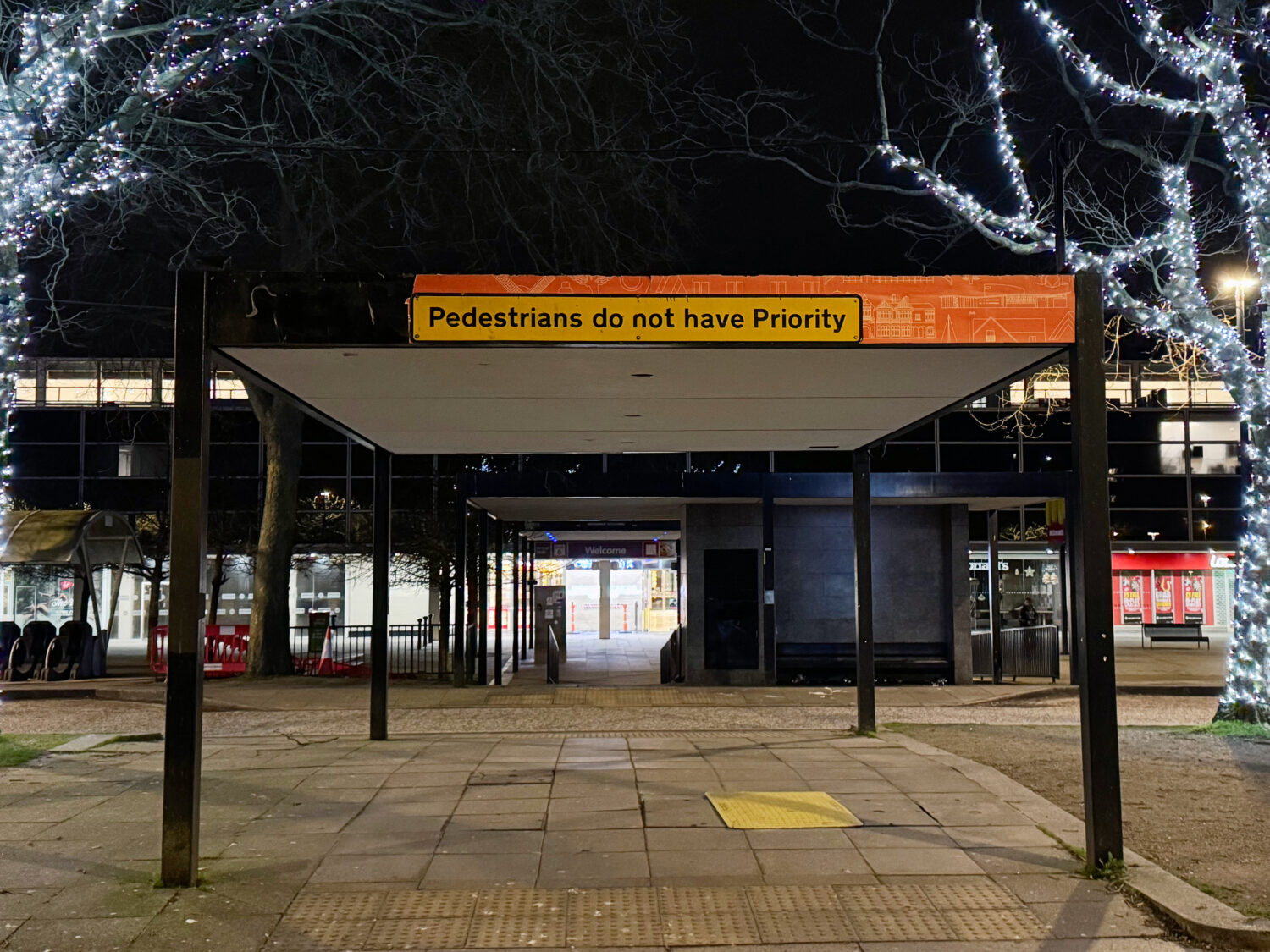
Pedestrians do not have Priority
On one side, ‘The Point’, an entertainment complex once the fluorescent peak of the town’s social life, now extinguished and derelict. On the other side, the McDonald’s entrance in the shopping centre (Maccy’s is still going strong). Between them, a long, straight, American-style road: Midsummer Boulevard.
Roads behave differently in America, they relate differently to their places. A few years ago, I ended up in Kent, Washington, for a roller derby tournament. It was my first time in a small American town, and I was grabbed by familiarity. The layout had a sense of my ‘new town’ childhood. Buildings all stationed neatly between systems of roads. Foundational. 7
East London, my current home, is the opposite. Roads squeeze and bend, around and between buildings. The unplanned. Decentralised accumulation, layering from all angles. Assemblage of existence. A gathering of matter, swept in by tides of lives and dropped piece by piece. Nacre: a composite of debris of multi-generational existences, forming a pearly place, grown from the inside out.
A long, straight main road feels rare here. Where similar roads occur, there is significance: ancient history. The few dual carriageways, developments of old highways, feel haphazard and compromised: rising and falling, bending and bowing, intersected at irregular intervals with bridges, junctions, tunnels. There’s a hierarchy of placement. In London, roads answer to the people. In Kent, Washington, and in Milton Keynes, England, the opposite is true. Roads at the start. Linearity of time and space. Milton Keynes was spelled out. A couple of the old signs remain on the porte cochère over the pedestrain pavement spanning the boulevards: they read ‘Pedestrians do not have Priority’.8
But there are sub-contexts. ‘Redway’ cycle paths surround and weave into every estate. Growing up, we didn’t have a car, but I never felt cut off. ‘MK Metro’ buses ran routes through and between every estate for cheap. My 45-minute journey to school, the full length of the city, cost 25p on my bus card. Access had value. The difference now is stark: Arriva serves only the profitable routes. Your isolation is not their concern.9
An abundance of open space. As teenagers, we hung around outdoors in the central district, which was a mix of civil institutions and office buildings. Among them all were spaces for being, for gathering, for noticing. Lawns, water features, sculptures. And benches, long enough to lie on, which stayed dry thanks to tiny, repeated holes in the design. The sensation of putting my little finger into the holes in those benches is etched into me.
Today, I look up at the skeletal remains of the half-demolished ‘Food Court’ building, and I remember the wealth of open space it had. How unusual that feels now. So much marble. Floors and planters surrounded by blocks for sitting, in the company of thriving semi-tropical plants. Breathe with us. When we needed somewhere out of the wind to skin-up, we would sit there.
We never got moved on, rarely even approached by staff. No private security guards in their fake-cop outfits – the staple of every public-looking private space these days. Commodification. The ‘winter gardens’, a beautiful heated indoor tropical greenhouse space that I played in as a child, have been shut off from public access, and are now only available through Bannatyne’s Gym. A spa experience. That used to belong to us.
[7] The grid road system is one of the famous signifiers of Milton Keynes. ‘Isn’t that the place with all the roundabouts?’. The layout operates across perceived, conceived and lived space. Speaking about the road grid Roland Jeffery references its prioritised status in the ‘Master Plan’. He also points to how the layout and wider planning systems sought to interpellate citizens with the subjectivity of ‘consumer choice’:
‘The master plan specified a hierarchical road grid as a prime determinant of the new city, a completely new morphology for the United Kingdom; a new Central Area (not a ‘city centre’), displacing Bletchley; a decentralisation of employment and retail across the city; consumer choice through a variety of housing, schools and leisure spaces; very extensive open spaces and a notably low overall density. … The road grid and its landscapes give Milton Keynes its distinctive sense of place. Many grid roads were built well in advance of buildings – in defiance of usual practice – as a statement of intent to irrevocably establish the grid plan while central government money was still flowing. The Development Corporation feared that it might be abandoned if not built early and many surreal photos of Milton Keynes in the 1970s show unused dual carriageways linked by roundabouts marching across agricultural land.’ (Jeffery, 2012)
[8] Over recent decades behaviour regulation has become less overt. Parking at Milton Keynes Shopping Centre was originally free (as advertised in 1980 https://youtu.be/lH_3Ht2pC0s) but gradually moved to a colour-coded system of pricing with areas of peak and reduced cost that shift with distance and demand, monitored and revised through payment apps and ANPR camera systems.
[9] Made with red tarmac, redways are a network of foot and cycle paths extending the length of Milton Keynes. Developed as a secondary layer of mobility, they were conceived as a corrective to the grid road system, creating routes that move beneath and above major roads (Hobson, 1999).
Over time, even well-intentioned top-down design has been unevenly lived: cycle paths decay in more deprived estates through lack of maintenance, while a now-privatised bus service, its routes dictated by profit, no longer serves the full community (BBC, 2024). Inequalities in access to mobility in Milton Keynes deepen inequalities between localities recursively. As Cresswell notes, “The very design and operation of infrastructure are imbued with political and social assumptions about who should move, where, when, and under what conditions” (Cresswell, 2012).
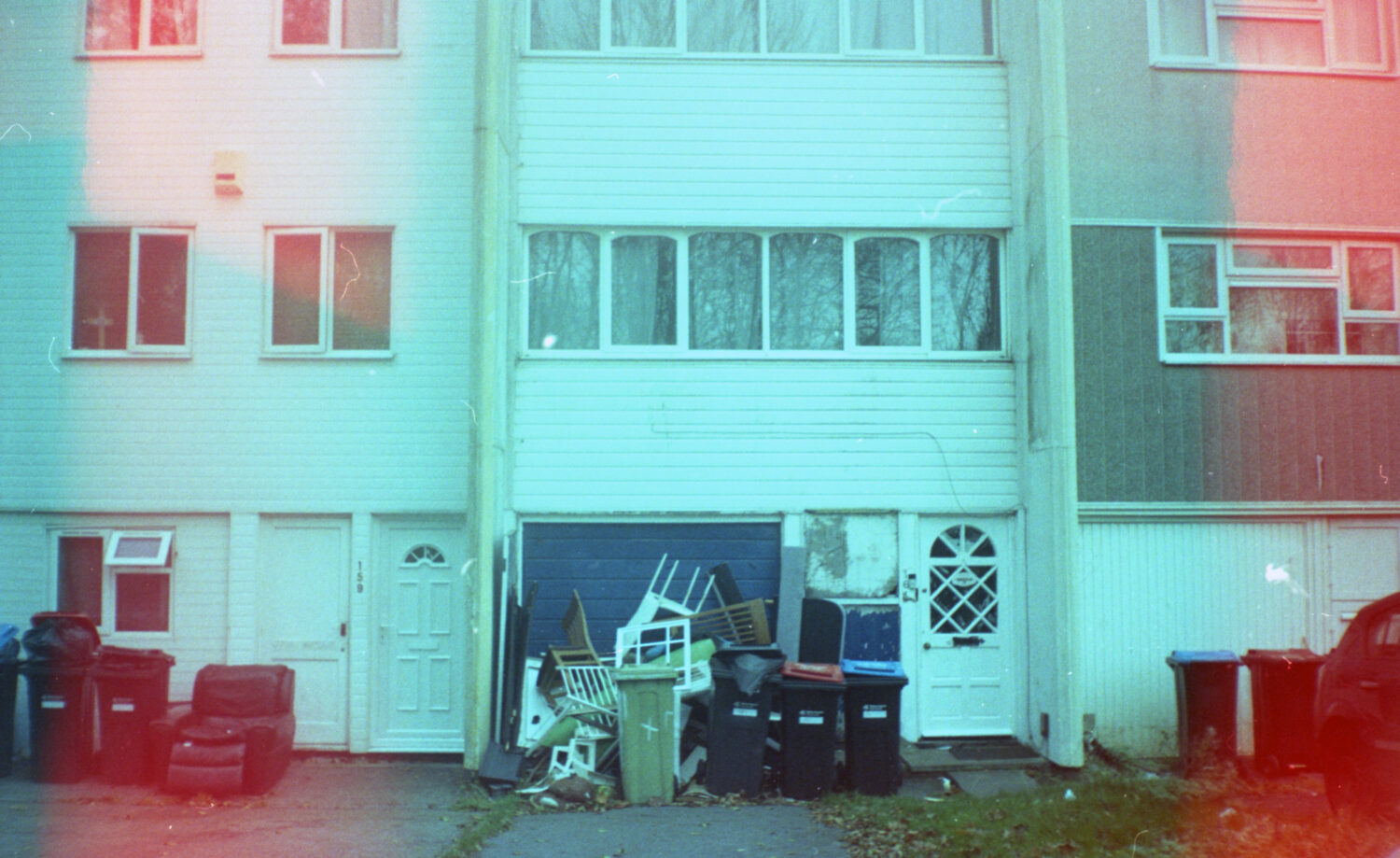
Nether Field
The houses are so uniform, in their shape and their materiality, like a sci-fi reimagining of terraced housing. Regularity, repetition, consistency. 10
The rooflines of each row cut across the sky in long straight lines, and yet the ground levels of the houses vary with organic variation of the land. Undulations, ups and downs, gentle bobbing. The waves of melody are punctuated by the rhythmic beats of the houses. A song of an estate. Familiar but changed. Ghostly. People always used to say it was supposed to be temporary and that the houses should have been demolished by now. 11
Even as a kid here in the 90s, there was something that I understood was political about the modification of a few houses on each road. Unique facades, faux brickwork, timber details. I was old enough to know who Thatcher was, and as a social housing tenant I knew the words ‘Right to Buy’. These people owned their houses, a signifying code I knew: financial status symbols, ‘social mobility’.
2024, there’s an eerie inversion. Still Netherfield, still perched in its supposed perpetual position on the precipice of a fate to be decided in an office somewhere removed. But there is a regeneration programme underway. New facades for the council houses. And those few bought out through ‘Right to Buy’ now stick out as ageing, discoloured, rusty relics of the age of the aspirational middle class.12
As a kid I always thought the houses were ugly. It’s only now, holding archive photographs of the newborn estate while I stare at the sterile, smooth regenerated facades, that I start to develop a nostalgic appreciation for the aesthetics of the original modernist designs. Mears are in charge of the regeneration work – the housing crisis isn’t a crisis for everyone. 13
Once I saw a 70s video of a house in the neighbouring estate of Tinkers Bridge. It was totally idyllic. It triggered a transformation, imprinting permanently onto the montage of memory, knowledge and intensity. Deeply rooted and heavy flashes of experience ignite my senses. Inextricable is the sensation of my heart in my stomach as my 12-year-old boyfriend enters his bedroom, face hot and red, fighting back tears. I know that the walls of this beautiful architecture are thin enough that the sound of a beating from a stepdad spills through like a double assault. The smell of Lynx Africa. Fear, rage, injustice, paralysis. Design, hope, suffering, resolve, all knot together. Multiplicities tethered gently to a spot on the ground. 14
Same in Netherfield. Associations are visceral. Curiosity, lust, freedom, fear. The burning of lactic acid coursing through my legs and the thudding of my heart in my chest, lying down hiding behind a bush, breathing silently, desperate to evade discovery by a furious neighbour. Clues reverberate between memories, ideas and the environment. Behind, opposite, in, on top of, beyond, between, beneath.
No phone, no map. Objects. ‘Meet me at the giraffe’. People out and about. The local centre. The pub was always overflowing. Regulars, locals, drinking, laughing, talking, fighting. Someone always knew someone who knew you. The pub’s outdoor space is now home to a group of metal poles jutting violently out of the ground. The pub is a B&M.
I pass the row of garages, mostly derelict even though back then it was our best playground. I get to the swing park. A skeleton remains but the flesh has been reabsorbed into the earth. Rust consumes the metal frame. No swing hangs from it. That swing set saved my life. Vivid replay of climbing to escape the dog that was chasing us. I can still taste the blood rising in my chest. This place does not exist to me without that memory making and remaking it always.
[10] I read online that the word ‘Netherfield comes from an old field name recorded in 1781, and literally means “Land that is Low-Lying’. Netherfield was built in 1972-77, a 50 Hectare site with a total of 1068 dwellings constructed from timber frames with aluminium flatroofs and metal/timber cladding. (Walker, 1982). Michael Gold, among the architects behind the projects, recounts: ’We were instructed to design at the maximum conceivable scale for single construction contracts, in order to quicken implementation of the city. … Our reaction was to consider each grid square as potentially a village or small township, to be compacted in density and set in the residual landscape, full local facilities to be fought for. (https://www.michaelgoldarchitects.co.uk/netherfield)
[11] From the moment I first set foot on the estate in 1995, there was local folklore about the built-in lifespan of the estate. The story was that the materials were specifically chosen to be cheap and disposable so that, once the town had been established, the estate could be levelled and rebuilt. This was plausible to me as a child, because I knew nothing of modernist architecture or the designers’ aspirations for the estate, let alone the negotiations between the architects and the Development Corporation. I knew it only as a council estate, filled with other poor people, who in my experience were fair game for displacement, in dwellings that were visibly in a process of decay. Darren Umney, writing after a 2017 art project focused on Netherfield, highlights how the estate seems to be suspended in limbo: ‘The architects’ idealised conceptions of how residents might live in their new homes, as envisaged and preserved in the archival record, now contrasts sharply against how the ideals and the homes have survived. The surviving structures, like the ideals, are not in ruins but they are not well preserved.’ Yet Netherfield was just one example of a much wider pattern in post-war planning, which Umney describes as ‘an unfortunate error, created together in a young and naive past when ideas about how and where people would live were still infused with the optimism of the post-war consensus.’ (Umney, 2018)
[12] Milton Keynes had specific targets for 50/50 home ownership ratios but Netherfield was entirely social housing (The Architects’ Journal, 2017). The fifty-fifty plans soon succumbed to the Right to Buy scheme, introduced by the Conservative government in the 1980s, which allowed council tenants to purchase their homes at a discount, reshaping many estates through a mix of private ownership, resale, and long-term fragmentation of tenure. According to research by the New Economics Foundation, 73% of sold-off social homes in Milton Keynes are now being privately rented. (New Economics Foundation, 2024)
[13] The film Milton Keynes and Me features archive footage of the new houses. (Milton Keynes and Me, 2019)
[14] Space is not static. It is swirling, breathing, digesting fluidity. Space is ‘social morphology: it is to lived experience what form itself is to the living organism, and just as intimately bound up with function and structure’ (Lefebvre, 1991). Processes of exploration, concentration, reflection and explanation all contribute to its production, reproduction and transformation.
Fiction Non-Fiction and Reference
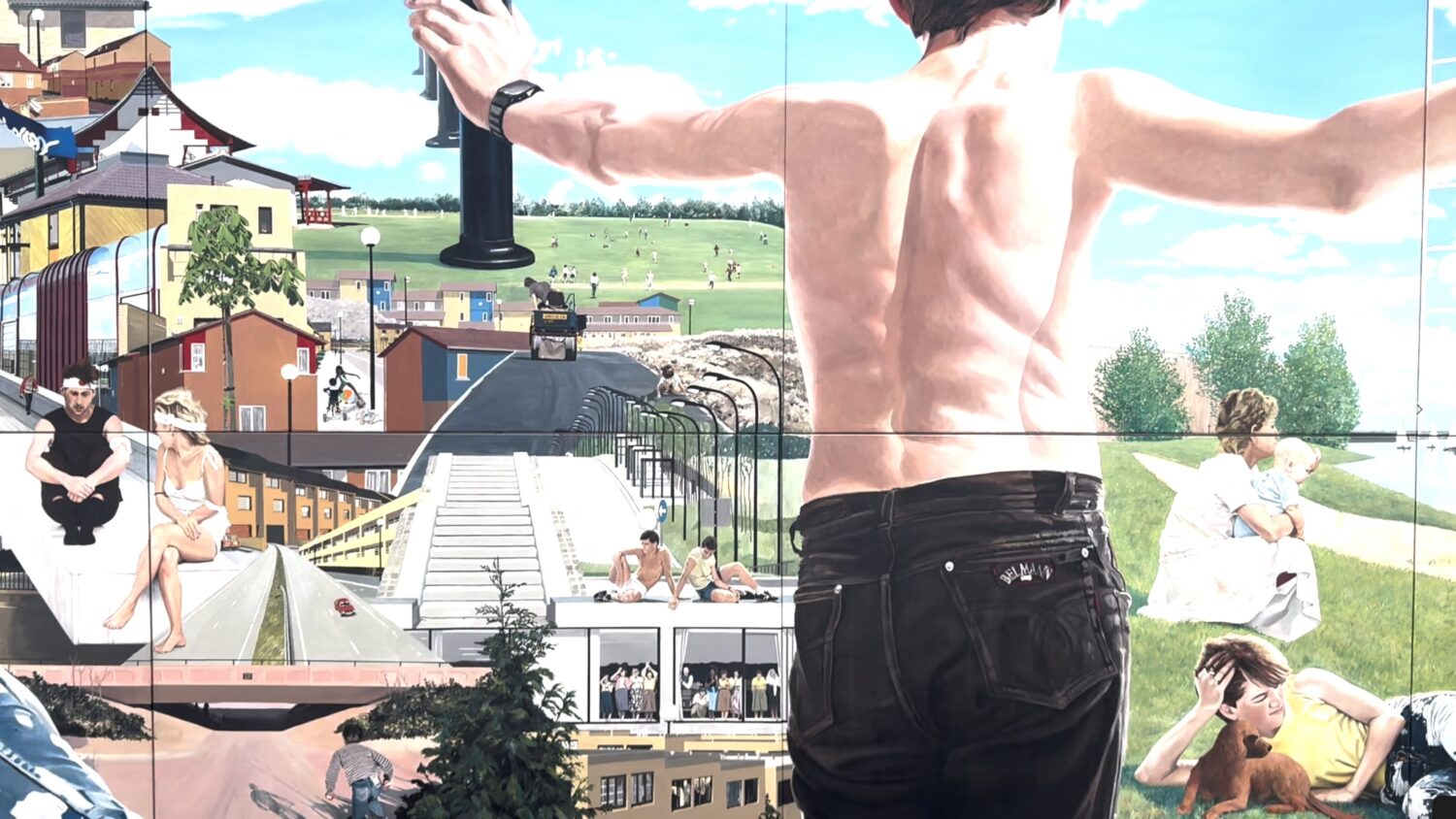
The painting affected me. I can recognise it but not explain it. 15
I paid attention to it. A tension. Many threads of tension connect us. From moments in it to moments in me. The library, the painting’s home, is an invitation to be somewhere, as well as to travel to infinite places. There is no extraction, no transaction, a generosity for curiosity. 16
The full length of the painting is viewable from this balcony halfway up the stairs. Why is this landing here? Was it built to be a viewing platform? The length of the landing perfectly mirrors the length of the painting. Intentionality of planned development. 17
Do I need to understand how, to know that this painting contributed to who I am now and how I live my life?
An embedded sense that relating to art, time spent looking, practises of wondering, is for everyone. And that there is power in it. Content which tells a story of potentiality, complexity, contradiction and the malleability of reality.
Do I need to understand how this painting contributed to who I am now, and how I live my life? I carry an embedded sense that relating to art (time spent looking, practices of wondering) is for everyone, and that there is power in it. Content which tells a story of potentiality, complexity, contradiction and the malleability of reality.Its scale is massive.
It felt massive when I was 7 years old, and it feels massive now. As I look at it, I can feel the sensation of leaning on the cold metal pole which runs along the landing, my body’s memory landing, on constant rewind. So many hours spent there.
The scene is recursively familiar. I always knew it was a painting of things I knew, places I knew. The mirrored buildings in the right-hand corner and the way they reflect the clouds in the sky. Every time, I am reminded of the first time I arrived at Milton Keynes train station, aged four, surrounded by mirrors. Sky reflected to infinity.18
The painting knows me. It knows about my life. It knows of me as a child, connected to an artist through this painting, because of the place I am in and the place it is in; the place in it and the place that is in me.
Newness everywhere, not a single building looks worn or old. In my early relationship with this painting, so many spaces in Milton Keynes looked like this.
The estate I lived in, Walnut Tree, was still half a building site. The edge of the city was all semi-permeable boundary between Milton Keynes, not Milton Keynes, and the ‘Milton Keynes yet to be’. Surreal. Blurred lines between recognisable reality and fictionality; a montage of jumbled perspective; an opening for something else.
A giant figure leans a finger on a building-sized column and their other hand on a black post which repeats, stretching out into the sky. Margaret Thatcher waves from the top of some stairs with Arthur Scargill looming behind her. The way the foot and knee spill out of the otherwise straight and clear-cut boundary. There is no frame.
[15] It resonates; it amplifies. “The relationship between the levels of intensity and qualification is not one of conformity or correspondence, but of resonation, or interference, amplification or dampening.” (Massumi,1995)
[16] Fiction, Non-Fiction and Reference was created by the artist duo Boyd and Evans during their time as ‘Artist in Residence’ in Milton Keynes, from 1982 to 1984. Funded by the Milton Keynes Development Corporation, they lived and worked at Stacy Hill Farm, now the site of Milton Keynes Museum. The painting was made for MK Library, where it has its permanent home. In 2023 it was moved temporarily to Milton Keynes Gallery for a retrospective exhibition.
[17] In a strategy document published in 2006, Marie Kirbyshaw, the ‘Senior Public Art Officer’, reflects on the Early Years Public Art Development (1965–1985). While approaches varied, she notes a common factor: placing art ‘objects’ in the environment ‘to create “a new relationship between art object, space and people.”’ She observes that ‘some may suggest this was an early attempt to develop “sense of place.”’ This was ‘typical of the 1970s/80s modern movement, where art was used “in designing new towns”’ (Kirbyshaw, 2006).
[18] According to Althusser, ideology de-historicises by presenting a social condition as immutable and unchanging. Fiction, Non-Fiction and Reference reflects Milton Keynes back to the viewer, in a constant loop of attention to temporal context. It continuously re-historicises.
Art Centre:MK
My parents worked long hours and I spent every day after school in an after-school club and every holiday in full-day ‘playschemes’. One summer an artist visited to collaborate with us kids to create a mural for the underpass connecting two estates. 19
We worked together to paint a background sea scene, and we each designed our own fish for the shoal. I don’t remember what my fish looked like. I don’t remember whether I thought it was successful, or if I was proud of it aesthetically. But I walked under that underpass every day until I left that school, and I felt connected to it. It was mine. It mattered to me that I was able to impact my environment. 20
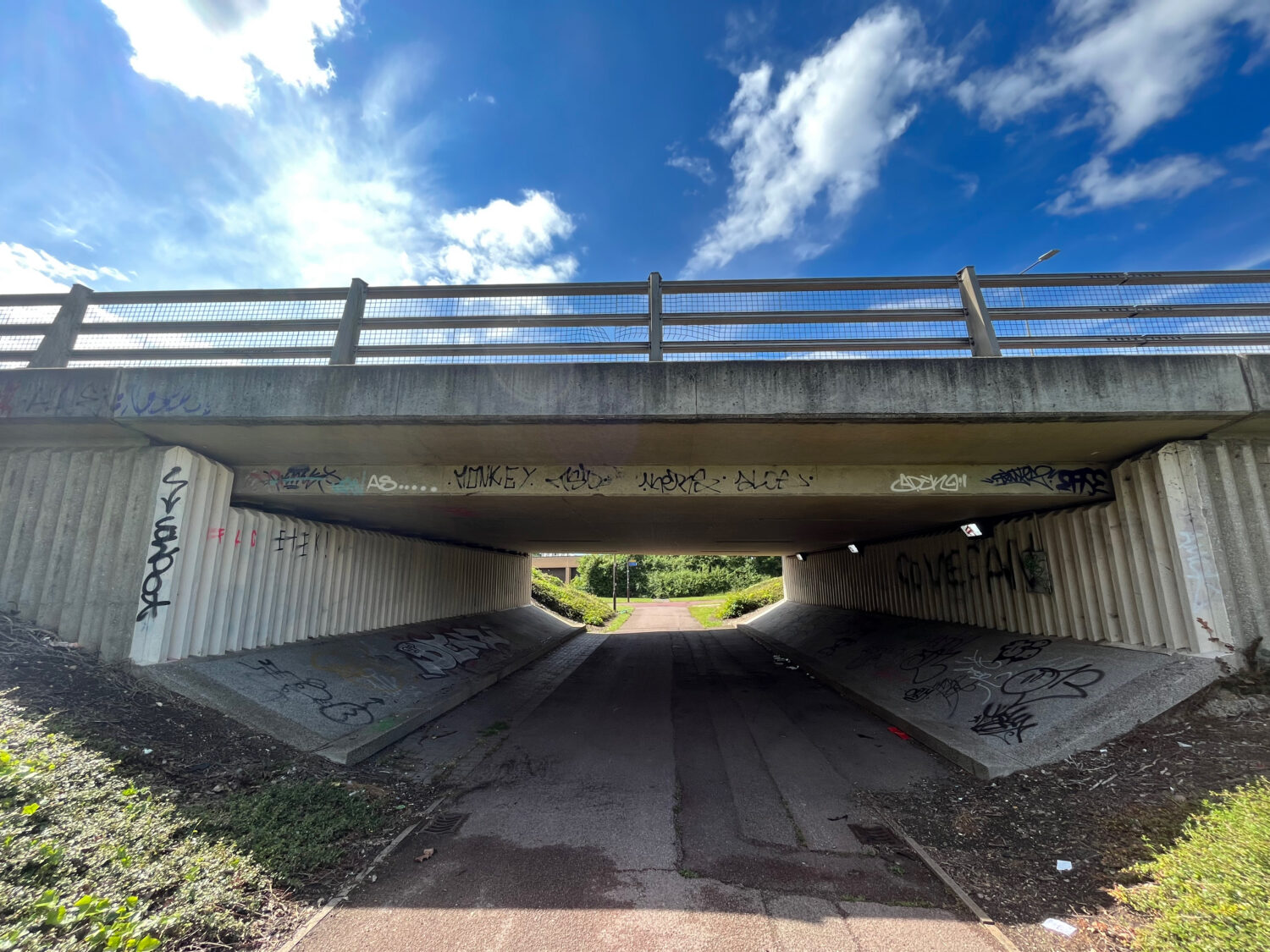
My brother got expelled from our catchment school the year before I moved up so we both ended up at a secondary school on the other side of town. There was a carpool for the mornings, and most days we drove up the V8 under a bridge which had the words UNSTOPPABLE NATURE POSSE sprayed on one of the struts. It wasn’t complex, just black letters sitting contrast against the white pillar.
The balance of it mesmerised me. It was a narrow bridge, and the letters were tall, skinny, and squashed together so evenly. The skill of it is rooted in me. I glanced at it every day, a different quality of attention: fast and fleeting. I had to steal my looks. Sustained regularity. I anticipated seeing it. It became tied to my mornings, to the pattern of my days. I wondered who painted it. I knew it belonged. I remember the sense that something was wrong when it got buffed.21
Graff wasn’t really prevalent in Milton Keynes in the 90s. Infrastructures had plenty of money and things got buffed too quickly for the perpetual growth to take root. Graffiti is life in motion. Cyclical. Potency of decomposition. Exposed and sterilised by the bright lights of a city rich in maintenance budget it can’t flourish. You can see this changing now. Across the city, but in specific areas too. Pockets left to brew quickly spill over with colour, line, voice and identity. 22
When my kids were still tiny, after a baby group meet-up at the bottom of the hill in Campbell park, I decided to walk up to the shopping centre. The buggy was heavy, and I was still recovering from c-sec surgery. The hill climb was intense. I remember the burn in my legs, and the sweat dripping from me. Since they arrived, I’d lived in the realm of adrenaline and cortisol permanently. The fear of not meeting a need quickly enough to spare physical or emotional damage dictated the landscape of my bodily functions.
I took a break halfway on a bench in a small, landscaped area that reminds me of a zen garden. There are ornamental bushes of red and green, displays of plants and a small stream, cast out of concrete. I knew they were sleeping, but a switch to being stationary could easily rouse them (for years afterwards I would rock habitually while standing in supermarket queues).
A couple minutes breath held, and I exhaled. Heavy bodily relief. Come down of hormones dropping from my face to chest to stomach and pouring out my fingertips and through my feet, connecting to the ground. My comrade, holding me up. Air, filling my lungs. Remembering my own flesh. Opposite me the stream grows in the middle to a rectangular pool. In it sits a shopping trolly, upside down. Pondweed hangs off the legs which jut out of the water.
Is this a sculpture? The question stings my attention. Is this supposed to be here? The exhaustion which saturates me tips me into a dreamy deep longing for understanding. A thread now grounding me back to the place I sit. Do I remember it being here? Off to my left is a tall red sculpture of figures stacked on top of one another; hands to hands, feet to feet. You can’t miss it.
The red sticks out above the trees. It has always been there. Like the figure 8 perched on water opposite M&S. Or the women whispering outside the library. Concrete cows. Milton Keynes iconography. Art objects are normality. This trolley. Or not? I sat. For maybe a minute. Maybe an hour. How would I know if it’s art? How would I know if it’s not? Does it matter? 23
Am I only paying attention to it because of my state of mind and body? If I didn’t have the buggy I wouldn’t have stopped. The silent sleeping company inside it which used to be me are my collaborators.
It’s not there anymore. It’s been buffed.
[19] Such projects were common alliances between the local civil institutions and community members. Fair notes that “Facilities, too, were realized collaboratively. Stantonbury Adventure Playground, for example, brought together MKDC, the local authority, and the Stantonbury Play Association” (Fair, 2024)
[20] By the 90s, collaborative murals had established themselves as a key tool of the ‘Community Arts Movement’: a loose term for a wave of socially conscious arts projects, beginning in the 1960s, which sought to engage communities in creating their own art works. ‘Many projects sought to engage children and young people, partly because this was seen as a gateway to “harder to reach” adults in their community. The emphasis was on the creative process as a social catalyst…’ Although, as Franklin notes, ‘Not all external murals, for example, were the outcome of a collaborative process and not all muralists saw themselves as part of the community arts movement.’ (Franklin, 2023)
[21] Whose voices are represented or marginalised in public and cultural spaces? (Schacter, 2023)
[22] “The perfectly clean city is still the professed dream, the dream of the entirely privatised, surveilled, spectacularised city, yet the war is not only about this (impossibly) pristine city itself. The war is about a conception of the private that continually shrinks public space. … This war is about the city as site of commercialisation, not habitation.” (Schacter, 2023)
[23] Public art sculptures. Are they tools of capitalist hegemony, weaponised to fuel the pockets of creativity required to keep capitalist enterprise running to its fullest potential? Are they sites of critical agitation which hold the seeds of resistance and revolution? Or do they hold the capacity to be both?
The Bridge
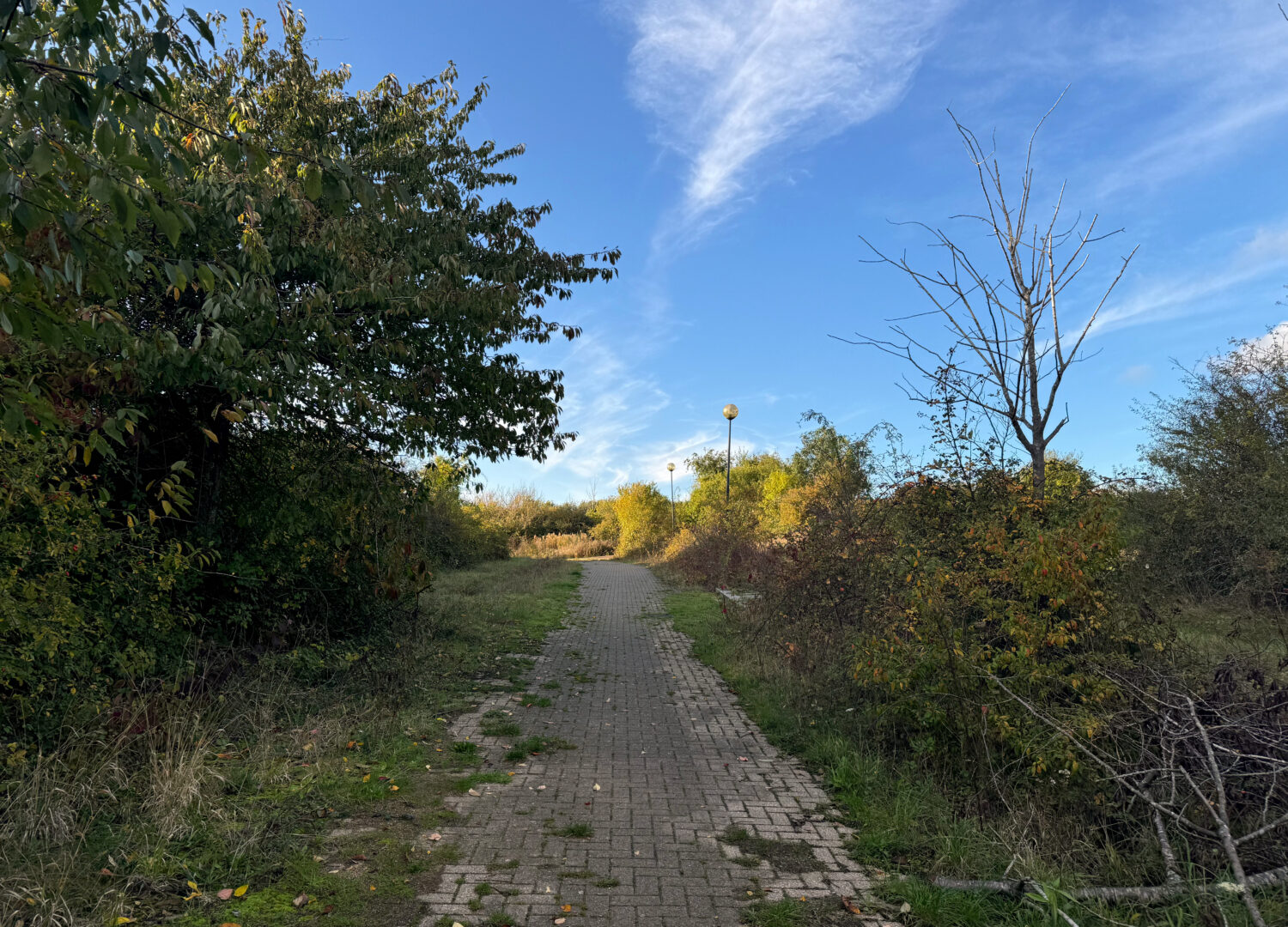
Unstoppable Nature. A path flanked by marble walls. These bridges, standardised design, head out of the rectangular city centre in all directions. Built the same, but this one is changed by time and ecological forces.
Weeds, growth, bursting from every crack. The undoing of reduced human disturbance: the bridge and the path leading to it are rewilding. Blackberry brambles rise and fall in arches of complete seasonal cycles. Further down the path a square of underpasses has become an autonomous zone art gallery. Ghostly. Why are all the lights out? Bushes left overgrown. Forgotten? Or a different kind of intentionality.
Cyclical seasons, ecological time. Milton Keynes was once a town of agricultural spring. Seedlings of communities planted, fed, nurtured. People-seeds collected and carried to the place from other densely established plots with the promise of space and fertile ground to grow. Cyclical movement.
What does it mean to migrate to a new town in the same country? Are you a migrant? I think of the places I come from: generational shadows of place in me.
A boom of Milton Keynes summer followed, and they want to keep it suspended there in a state of perpetual growth ever since. But this bridge whispers of autumn. A moment tipping over the peak towards a drawing-in, a stripping away. It needs the winter. Destruction. A route carved out for people, neglected, not taken up by people, being reclaimed by different kinds of life. Manifest dismantling.24
A town on levelled history. For a new town to exist, what was erased? What is a bridge? A connection, a networking link. This route is obsolete. A thread unraveling. Making space for something else.
Dialectical existence. Holding opposites. The plasticity of the brain makes and breaks neurological associations and connections. Manifest dismantling of the self.
What was Milton Keynes before? What life has been paved over? What life and ideas will fight their way through these marble ruins, seeking out the sun? 25
[24] The concept of manifest dismantling is introduced by Jenny Odell in her book How to Do Nothing as a deliberate counter to Manifest Destiny, the ideology used to justify westward expansion, territorial conquest and the displacement of Indigenous people. I use it here to consider what a counter to the ideology of new town development could look like, especially in the context of ecological destruction (Odell, 2019).
[25] As well as considering the potential of art, narrative and affective exploration of place, my investigation turns to the temporal impacts on physical space. Processes of decay, destruction and ruination open space for imagination and transformation: ‘Ruins may be used as sites from which to examine and undermine capitalist and state manifestations of power’ (De Silvey, 2013).
Bibliography & notes
All photographs by the author unless otherwise stated.
Althusser, L. (1971) Ideology and Ideological State Apparatuses. London: Verso.
Barkham, P. (2016) ‘Story of cities #34: The struggle for the soul of Milton Keynes’, The Guardian, 3 May. Available at: https://www.theguardian.com/cities/2016/may/03/struggle-for-the-soul-of-milton-keynes (Accessed: 20 January 2025).
BBC News (2024) ‘My daughter is stuck at home due to bus cuts’, 28 November. Available at: https://www.bbc.co.uk/news/articles/cn9xrge917g (Accessed: 22 January 2025).
Cresswell, T. (2012) ‘Mobilities II: Still’, Progress in Human Geography, 36(5), pp. 645–653.
Deleuze, G. (1994) Difference and Repetition. Translated by P. Patton. New York: Columbia University Press.
Deleuze, G. and Guattari, F. (1987) A Thousand Plateaus: Capitalism and Schizophrenia. Minneapolis: University of Minnesota Press.
DeSilvey, C. and Edensor, T. (2013) ‘Reckoning with ruins’, Progress in Human Geography, 37(4), pp. 465–485.
Fair, A. (2024) ‘“The needs of new communities”: social development, the new towns, and the case of Milton Keynes, c.1962–87’, Modern British History, 35(3), pp. 261–277.
Fisher, M. (2009) Capitalist Realism: Is There No Alternative? Winchester: Zero Books.
Franklin, G. (2023) Murals and the Community Arts in England 1968–86: A Thematic Study. London: [Publisher if known].
Hobson, J. (1999) New Towns, the Modernist Planning Project and Social Justice. London: UCL Bartlett. Available at: https://www.ucl.ac.uk/bartlett/sites/bartlett/files/migrated-files/wp108_0.pdf (Accessed: 17 January 2025).
Jeffery, R. (2012) ‘The centrality of Milton Keynes’, Twentieth Century Architecture, 10, pp. 102–117.
Kirbyshaw, M. (2006) Public Art Strategy: Milton Keynes. Milton Keynes Council.
Lefebvre, H. (1991) The Production of Space. Translated by D. Nicholson-Smith. Oxford: Blackwell.
Massumi, B. (1995) ‘The autonomy of affect’, Cultural Critique, 31, pp. 83–109.
Milton Keynes Citizen (2016) ‘Milton Keynes maternity services among country’s worst’.
Available at: https://www.miltonkeynes.co.uk/news/milton-keynes-maternity-services-among-countrys-worst-1183860 (Accessed: 19 January 2025).
New Economics Foundation (2024) ‘More than 4 in 10 council homes sold under Right to Buy now owned by private landlords’. Available at: https://neweconomics.org/2024/05/more-than-4-in-10-council-homes-sold-under-right-to-buy-now-owned-by-private-landlords (Accessed: 17 January 2025).
Odell, J. (2019) How to Do Nothing: Resisting the Attention Economy. New York: Melville House.
Plant, S. (1997) Zeros and Ones: Digital Women and the New Technoculture. London: Fourth Estate.
Schacter, R. (2023) Monumental Graffiti: Tracing Public Art and Resistance in the City. Cambridge, MA: MIT Press.
Sedgwick, E.K. (2003) Touching Feeling: Affect, Pedagogy, Performativity. Durham: Duke University Press.
Sinaï, Y. (2009) ‘Bioregionalism as a new development paradigm’, [Journal / Publisher].
Umney, D. (2018) ‘Every house on Langland Road: the production of archival, architectural and artistic spaces’, Cultural Geographies, 25(1), pp. 229–238.
Walker, D. (1982) The Architecture and Planning of Milton Keynes. London: Nichols.
Recent articles
Walking through places generates mental images we carry with us: glimpses of where we were and what we did. But can we be sure of that? Think of the image you carry of a place you’ve walked: its colours, how it unfolded, its texture, its sound. Always slipping, always being… Read more »
Known as Fòcara (from the Latin focus, meaning “fire”) in the Salento dialect of Southern Italy, the Fires of Saint Anthony in Novoli is a colossal bonfire lit annually in honor of Saint Anthony the Abbot, patron saint of animals. In this section of the Past Present Archive, we publish… Read more »
Unfolding through the city of Guimarães, Portugal, The Walking Body is an artistic research programme that explores collective walking as a methodology for situated knowledge, creative inquiry and engagement with place. Taking place across three consecutive editions (2024–2026), the programme has generated a range of artistic outputs: from drawings to… Read more »