

A murdered house
At some point in the early twentieth century, during one of her many travels to Scotland, Vernon Lee (the pen name of Violet Paget) visited the shores of Fife, then one of the country’s most heavily industrialised regions. Driven primarily by coal extraction and linoleum manufacturing, Fife’s industrial expansion left deep environmental scars that the region still confronts today. In this short, first-person account from her 1925 collection The Golden Keys and Other Essays on the Genius Loci, Lee recounts her reluctant walk to an old estate known as Kilmany House: cutting through a landscape of debris and fumes, she uncovers a long-gone world quietly undone by the heedless industrialisation closing in around it.
They had talked of Kilmenny House as a place I must be taken to see. And there had arisen in my mind, together with a faint disinclination to move, a bored vision of another of those old houses with old ceilings.
It is good there should be an old house, with (or without) an old ceiling, in every region of the globe. But to the wanderer over the earth’s surface and partaker of its manifold hospitalities there comes to be a sameness, almost an irksomeness, in the emotions which such a place inevitably evokes, so that the suggestion of another such gets mingled with the equally inevitable proposal to see the improvements in one’s host’s own premises or grounds, and even in his stables and garage.
Besides, once you have written about old houses or such like, there is apt to come the distaste for what savours of one’s trade, a vague reluctance also as towards one’s own particular form of exploitation, or let us say profanation, of God’s universe.
So I have shown no alacrity about going to see Kilmenny House, and should have felt no regret at leaving these Fifeshire shores without seeing it at all. But yesterday evening there, unexpectedly, it was—or more properly, there we were in its presence.
We had prosaically tried to secure a walk between the endless icy showers, and had gone along the beach looking for shells among the clammy green stones and the bands of coal refuse which the faithful tide has returned to this land polluted by gasworks and factories, with a care and a regularity touchingly different from the ruthless slatternliness of mankind.
After another day of blotted-out landscape, the sky was clearing towards sunset, and the opposite coast appearing fitfully, with Arthur’s Seat and the Pentlands. Ranged against the pale sea and paler land, with factory chimneys and colliery mounds behind them, was a fleet of cruisers and destroyers, for all the world like black gulls tucked down upon the water.
Soon there were no more shells to be found, but only nameless bits of metal and crockery; rusted kettles also, even the ignominy (O Amphitrite and all ye nymphs!) of a sea-tossed stays-busk.
Then, as we made our way across the seaweed and shingle, the pines and beeches gradually came to an end, and were replaced by black outhouses, stacks of blackened timber, and the spread of rusty railway trucks, iron shanties, and tall smoking chimneys.
The tide receded, defiled and languid, out of a forsaken quarry; even the greedy gulls disdaining such grimy human rubbish; and presently we were picking our way among rails steeped in inky puddles and inky mud.
The landscape did not lack (such places never do!) for human habitations—black stone cottages with pathetic efforts at gardens; and we met two little girls wheeling a tiny baby in immaculate frills, the only flowers—children and frills—which industrial mankind still brings forth quite unstintingly.
For the vegetation had suffered not a sea-change (the sea was a few yards off), but a man-change: on the rocks and behind the wood-stacks and factory palings and railway lumber, tall beeches and great sycamores printed on the wet sky their leafless and blackened branches; blasted not by premature cold (for we are but in August, and all around is vivid green and richly leafy), but by chemically poisoned air and soil.
Even the ruins, dating from Cromwellian times, of Kilmenny Castle, step-gables and turrets overhanging the water, looked only like another discarded factory shed.
Among these dishonoured skeletons of trees, in rank grass, rose two tall gate-posts of floridly carved stone, pompously surmounted by shapes like crowns or birdcage clocks. And passing between them, across wet weedy lawns, we came, beneath those almost leafless trees, to Kilmenny House.
Looking seawards it has a flat balustraded front of dignified Palladian kind. But towards the fields and the Fifeshire hills (hidden by the encroaching factories and their railway yards) there is a façade of late seventeenth or early eighteenth-century style, with two great square flanking pieces, roofed each of them with stately domes of silvery slate, fitted exquisitely over the carved raftering one feels below.
The house, which has become uninhabitable by the encroaching propinquity of the factories and gasworks and goods station, with their appropriate screechings and belchings, now serves only as the warehouse of the adjacent linoleum works, whose fumes of rancid tallow are wafted thence for miles across the fields.
It is, moreover, eminently haunted, and the caretaker sleeping in that dismantled place has told of strange ladies seen and heard at nights, let alone a much more ancient ghost, known already in George Viscount and Wilhelmina Viscountess’s days—a green lady who once haunted a ruined well in the park, but who has doubtless long departed with the green leaves which were her rustling garment, withering away, as even ghostly ladies must, in the stench of chemicals and railway soot.
Few houses have so much the air of being built for delicate hospitality, divorced from the grosser pleasures of hunting or shooting; offering mere witty conversation, courtship, and at most such games as men and women partake in together, and which serve merely to train in graceful yielding to one’s neighbour’s skill or luck, and winner’s chivalrous offer of a revanche.
And certainly I have never seen a house having less of the liveried dreariness of princely dwellings and their lean, humbled parasites. Here, at old Kilmenny House, under George Viscount and Wilhelmina his Viscountess, all must have been equals, and all of the same high-bred simplicity and grace.
Persons, as I feel their vanished presence, of parts, as the eighteenth century phrased it, but of sensibility also, such as Sir Joshua paints, all unconscious of Hogarthian vileness.
The passionate currents of Rousseau flowed in their souls, and the melancholy of newly discovered Ossian, deep below the rippled surface, suddenly bursting forth with pathetic longings as in sonata adagios, to be checked into orderly energy of allegros and ironical dainty scherzos; music, like that of Haydn and Mozart, seeming these people’s appropriate ghost, and such as I can imagine haunting that murdered house.
Let alone all the noble dwellings which have decayed through poverty and neglect, half the houses ever built have, after all, died violent deaths from fire or warfare or what is called improvement, their very material often carried elsewhere to serve for building. But this particular house has been murdered slowly, silently, and stealthily by poisoning.
It looks inhabitable, with a fair show of order inside and out, but no one can inhabit it, and it has pined away, with beauty undiminished, like some romantic lady doomed to lingering death by a low-born lord who had no use for so much dignity and sweetness.
It being Saturday evening the linoleum and all the other works were closed, not a creature about them stirring. The window-panes stared black from the uninhabited rooms. Except for the whiff of gas from the adjacent works, the air smelled only of wet spoilt hay and distant seaweed.
And only the rumble of an antiquated goods train, a rusty contemporary of the Puffing Billy which stands on the bridge at Newcastle, broke the silence as its cotton-wool steamed slowly forth and lay fleecy on the soaked pale fields and pastures towards the spectral Fifeshire Lomonds.
As already said, I had felt at once that what haunted this murdered house must be music; and (disgraceful to relate) I was already profaning the place and hour with a sketched-out story, when reality, which is more imaginative than our poor fictions, did the thing for me, and banished the abortive tale of Kilmenny House into the limbo of untold tales.
For when we had turned our backs to it, and were returning home on the other side along that very beautiful bay, we came to a tiny old village, saved from the accursed fumes of that murderous industry by a rocky promontory which hid Kilmenny, its house and its factories, from view.
Just as we were turning up one of the steep flights of steps which (together with red roofs and nasturtiums against whitewash) give these Fife villages an odd air of Northern France, I was arrested by a jangle of music.
It came from one of the cottages which proffer buns and bull’s-eyes to the Kirkcaldy trippers, and boats wherewithal to dabble among the seagulls in the muddy river-mouth.
A jangle of chords and staccato one-two-three-four, which sounded, for all the world, like that of a harpsichord, and which, to the ear of fancy, turned some music-hall ditty into something sonata-like and poignant. The ghostly voice, I recognized, of the weirdly poisoned house.
Footnotes & references
From The Golden Keys and Other Essays on the Genius Loci, John Lane the Bodley Head, London, 1925. Available here: https://digitalcommons.colby.edu/cgi/viewcontent.cgi?article=1001&context=vl_published
____
Further Reading:
McNeill, Carol. Fife at Work. Stroud: The History Press, 2016
SEPA, Dealing with land contamination in Scotland. A review of progress 2000-2008. Available here: https://www.sepa.org.uk/media/28314/dealing-with-land-contamination-in-scotland.pdf
Whatley, Christopher A. The Industrial Revolution in Scotland. Cambridge: Cambridge University Press, 1997
____
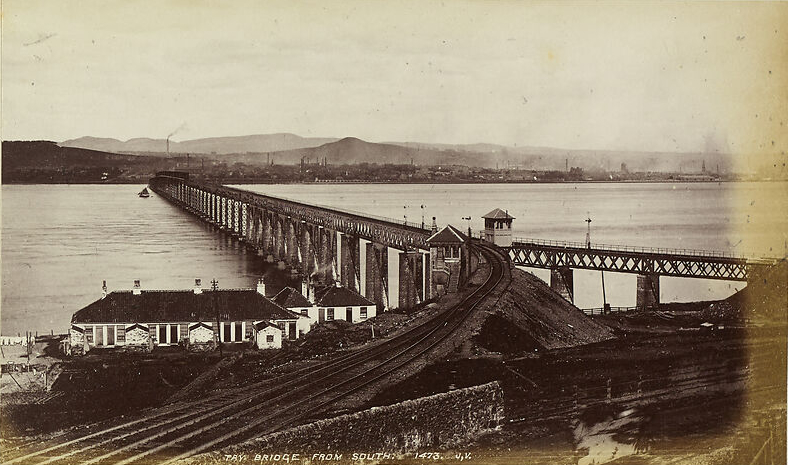
Cover image: ‘Tay Bridge from south’ (late 19th century) by photographer James Valentine, showing the bridge connecting Dundee to Fife as seen from the Fife bank. From Dundee Old and New, accessible through the National Library of Scotland.
Recent articles
Walking through places generates mental images we carry with us: glimpses of where we were and what we did. But can we be sure of that? Think of the image you carry of a place you’ve walked: its colours, how it unfolded, its texture, its sound. Always slipping, always being… Read more »
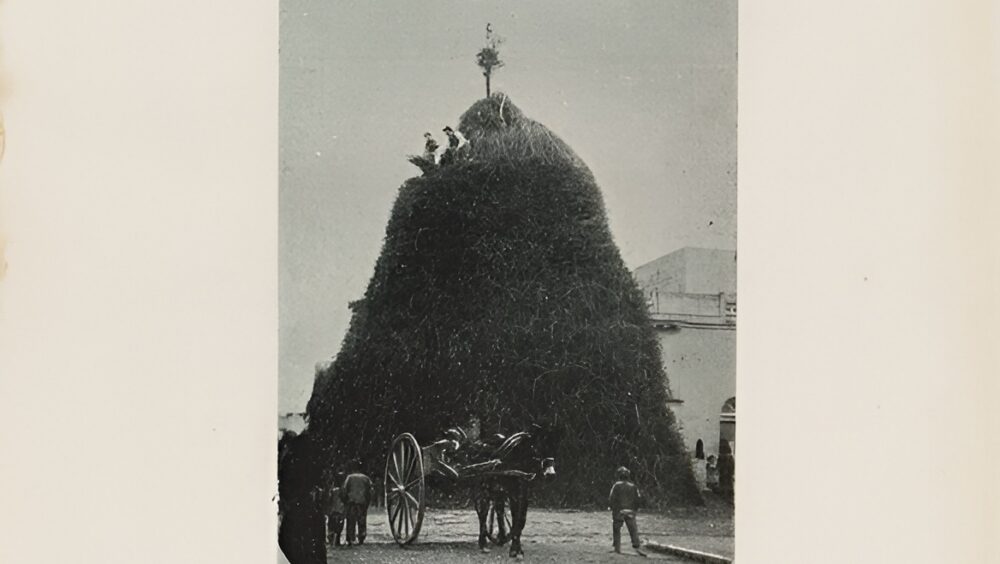
Known as Fòcara (from the Latin focus, meaning “fire”) in the Salento dialect of Southern Italy, the Fires of Saint Anthony in Novoli is a colossal bonfire lit annually in honor of Saint Anthony the Abbot, patron saint of animals. In this section of the Past Present Archive, we publish… Read more »
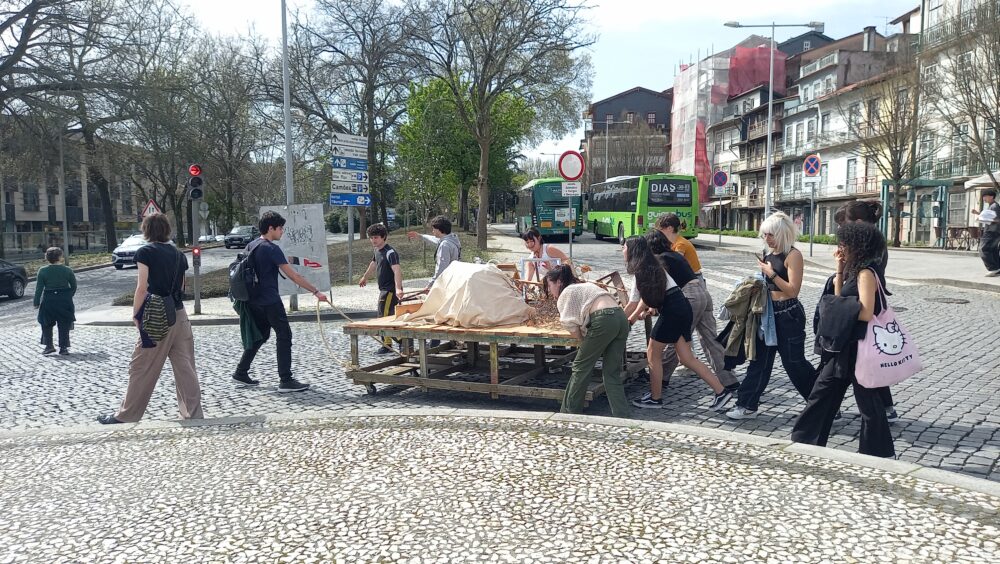
Unfolding through the city of Guimarães, Portugal, The Walking Body is an artistic research programme that explores collective walking as a methodology for situated knowledge, creative inquiry and engagement with place. Taking place across three consecutive editions (2024–2026), the programme has generated a range of artistic outputs: from drawings to… Read more »