

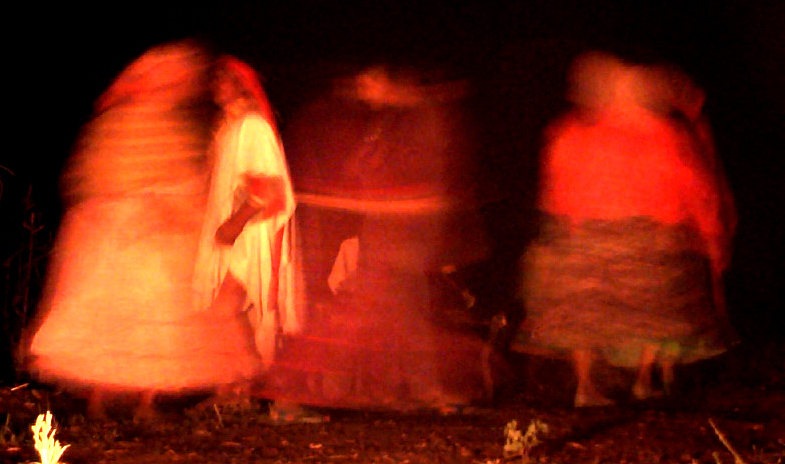
Danzar o morir on the Sierra Tarahumara paths
For our third contribution to the WALC project, movement on foot takes the form of long-distance running and ritual dance among the Ralámuli of Mexico’s Sierra Tarahumara, a practice that holds the power to heal and sustain the world. Author Sylvie Marchand has lived among them for years and reflects on this ritual through a dialogue of perspectives: that of Erasmo Palma, Ralámuli poet and cultural guide, and the writings of Antonin Artaud, who passed through the Sierra in 1936.
From the very beginning, I left. To look at my culture from another angle. When the past and the future are out of reach, a desire arises; a desire for another country, another world, a world to come, whose form must be invented.
After eight years of juggling and tightrope walking in a small circus, I set off on foot with my camera, toward the places and people only reachable by walking. I fell into step with pilgrims on the road to Compostela, followed the Mardi Gras of Mamou, joined the nomadic herders of Mongolia.1
Then I walked through the deserts, with people fleeing poverty in the most extreme destitution. Without papers, they set out through the Arizona bush and the dunes of Tecate, where sometimes they lose their lives.
I walk with people fleeing war. Nubians, Beja, Nuba, and those who come from the Blue Nile region.
But today, in this early 2026 firmly rooted in the 21st century, I invite you to join me in the heart of the Sierra Tarahumara in the state of Chihuahua, to revisit el país de los Tarahumaras, the land that Antonin Artaud encountered in 1936.2
It is here that I feed my search for the ritual roots of art,3 alongside the Ralámuli. Conscious of the belonging of human beings to their ecosystems, the Ralámuli call on us to take responsibility for the future of the world. Their vision holds the biosphere to be a living organism, of which we are the nervous system. Let us then go and explore the movement of their walks, runs, rituals and dances, which trace into the earth the rhythm of community and shared life.
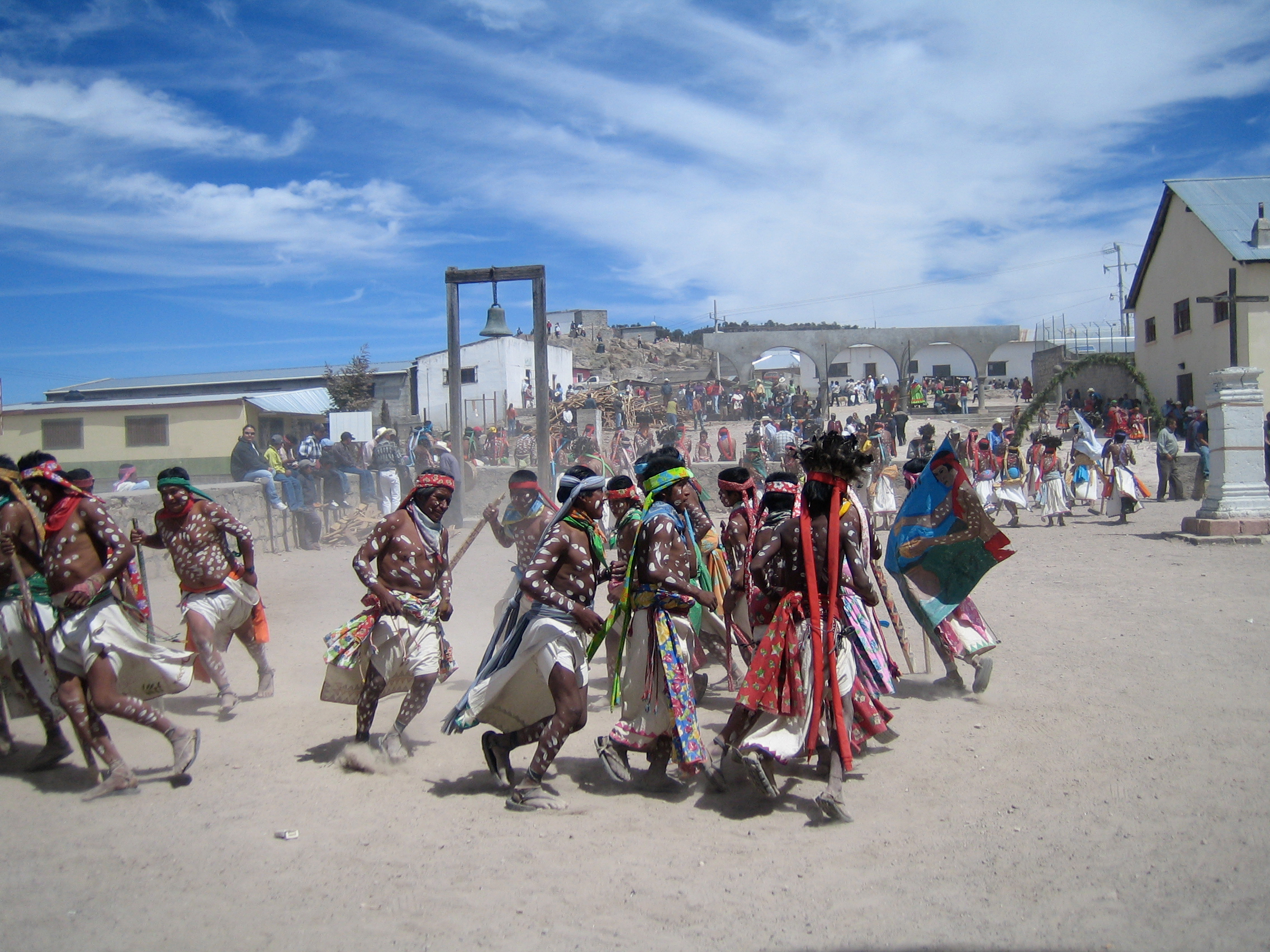
Photo: Sylvie Marchand
The connection between Ralamuri thought and Artaud’s writing.
From the moment I arrived in Norogachi in 2008, I heard tell of a French poet who had visited the Sierra long, long ago… I learned that it was Antonin Artaud. But the Ralámuli,4 a primarily oral tradition, didn’t have access to his writings.
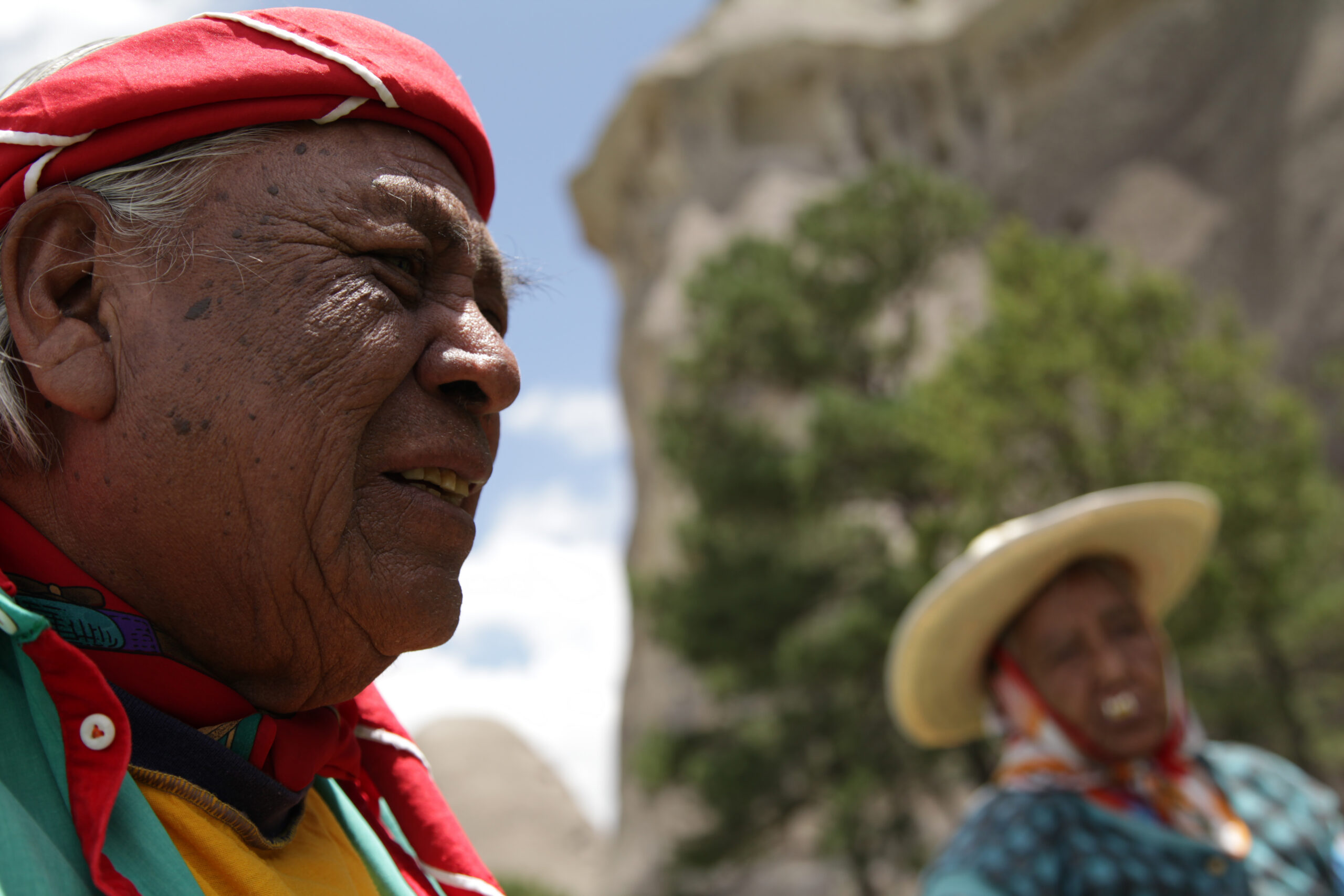
Erasmo Palma, from 2010 to 2016, in the final years of his life, introduced me to his culture and guided me through the works of Antonin Artaud. Photo courtesy: Lelio Moehr
In 1936, Erasmo Palma,5 aged eight, met Antonin Artaud. The French poet’s work would go on to influence Erasmo’s own creative path — he too would become a poet, and a spokesperson for the Ralámuli. It was Erasmo Palma who, from 2010 to 2016, in the final years of his life, initiated me into his culture and illuminated my way through the work of Antonin Artaud.
On our walks together, Erasmo, his son Chavo and his grandson Lucio guided me to Cowerachi, where, according to Erasmo, the French poet was initiated into the Hikuri, the peyote ritual.
For his part, in 1936 Antonin Artaud came to believe he had found confirmation, at the heart of the Tarahumara rite, that a sick world could be healed. He was thus able to affirm that ritual theatre is not a spectacle, but a bodily and cosmic experience, in which space, gesture and sound become vectors of transformation.
I continued my epistemological research with my friend the poet and linguist Enrique Servín,6 building a bridge between Ralámuli thought and the work of Artaud. Driven by the same quest, Enrique published Basalowala aminà ralálamuli paisila,7 his translation into Ralámuli of Artaud’s Viaje al país de los Tarahumaras.8 The two had at last met: the Ralámuli perspective on Artaud, and Artaud’s own words in their language, creating an equal exchange of gazes, each toward the other.
Antonin Artaud in the Land of the Tarahumara
I reread Artaud on location, in the heart of the Sierra. Artaud read the Sierra as ‘a land full of signs, forms, and natural effigies that seem not born of chance, as if the gods, felt everywhere here, had wished to make their powers known through these strange signatures…’. The poet deciphered a living landscape, dense with words, an ‘alphabet of the cosmos’ rising from the stones, as if the earth itself carried a language, exalted by the Tarahumara dances that inscribe their Signs into the Mountain..9
There, in the heart of the canyons, I grasped the force of the Theatre of Cruelty10 that Artaud had found among the Tarahumaras. Disillusioned by the Mexican bourgeois intellectuals who looked down on indigenous peoples, critical of the capitalist system that oppressed them, clear-eyed about the ecological threats weighing on the world, Artaud insisted that art and theatre must liberate the human being. Just as the Tarahumara rituals do, theatre must awaken the deep vital forces11 essential to life — so he proclaimed.
Modesto Moreno, a Sawéane from Norogachi, travels across the Sierra to share his healing dances and songs. Photo: Sylvie Marchand
‘In Mexico, bound to the earth, lost in the flows of volcanic lava, vibrating in Indian blood, there lives the magical reality of a culture whose fires would take little to rekindle.’12
The primordial bonds the Tarahumaras hold with the Earth, the Sun and Fire through their healing rituals, inspired Artaud to write two poems he named Tutuguri, after the healing ritual he described in the Sierra. Later, back in Paris, the poet-performer would embody the Sawéane in his public readings.13 He would bring the hammering of Tarahumara drums into his art. He would plant the incantations of the sipaàme — (the healer, the peyote rite) at the heart of the art forms that would later be known as performance and sound poetry.
Resistance and ritual struggles of the Ralámuli.
Erasmo Palma told me that ‘Ralámuli means human being, while the Mestizos and Chabochis14 call us Tarahumara; Humari means endurance. Hùmama means to run, to resist’, he would add. The name of the celebrated propitiatory rite Yumari is derived from this same root.15
After all these years, I have put down roots in the state of Chihuahua. The women around me in Norogachi organised a Yumari about ten years ago to adopt us — my son Lelio and myself. Since that ritual of initiation, I have been able to wear the scarlet dress and the collera, the red Ralámuli headband, and dance alongside them. I am grandmother to a little Sewa — Flower — the pride of my life, my most beautiful gift.
I admire the strength of the Ralámuli, who survived the conquistadors, forced labour in the mines, and the missionaries. But today they face new threats: drought, narcotrafficking, and extractivism.
And yet they hold firm — 122,000 people, and growing. They are one of the most significant indigenous groups in North America. Why? I would argue that the power of their rites can transform reality. They do not believe — they know: that to run, to dance, is a trial, physical yes, but above all an act of cultural, spiritual and artistic resistance, from which the whole community draws its strength.

Photo: Sylvie Marchand
The name “Ralámuli” has often been translated as “light-footed”, reinforcing the folkloric stereotype of the “marathon Tarahumara” — carried everywhere from tourist brochures to the coat of arms of the state of Chihuahua — and in doing so, obscuring the social and ritual function of their running.
For the Ralámuli, to run is not to win. It is to share, to resist, and to celebrate life in community.
In 2018, I created Voz Láctea16 with Lupita Castillo and a group of Ralámuli women — poets, singers, and teachers, all of them speakers of the Ralámuli language. This artistic project brought together a mosaic of women artists from many different ethnic backgrounds, around the richness of the mother tongue. Like milk, language is what we need to build ourselves. Artists from France, England, Colombia, Brazil, Argentina, Sweden, Spain, Italy, Chile and Germany were thus able to discover the artistic force of Ralámuli women, and to dismantle the Western stereotype of the ‘Tarahumara long-distance runner’.
Women run the ariweta: using a stick, they launch and catch a hoop made of plant fibre wrapped in coloured cloth. Men practise the rarájipari, a race in which two groups chase a wooden ball across tens of kilometres.
Several days before the race, the women prepare the apuestas — the offerings. Clothing, cloth and food are redistributed within the group after the event, according to a principle comparable to the potlatch.
At the heart of the Ralámuli worldview, the race is an economic, social and political institution, with a propitiatory purpose. At the opposite extreme from the Western sporting model built on competition, Ralámuli running aims at sharing, fertility and the wellbeing of all who inhabit the earth.
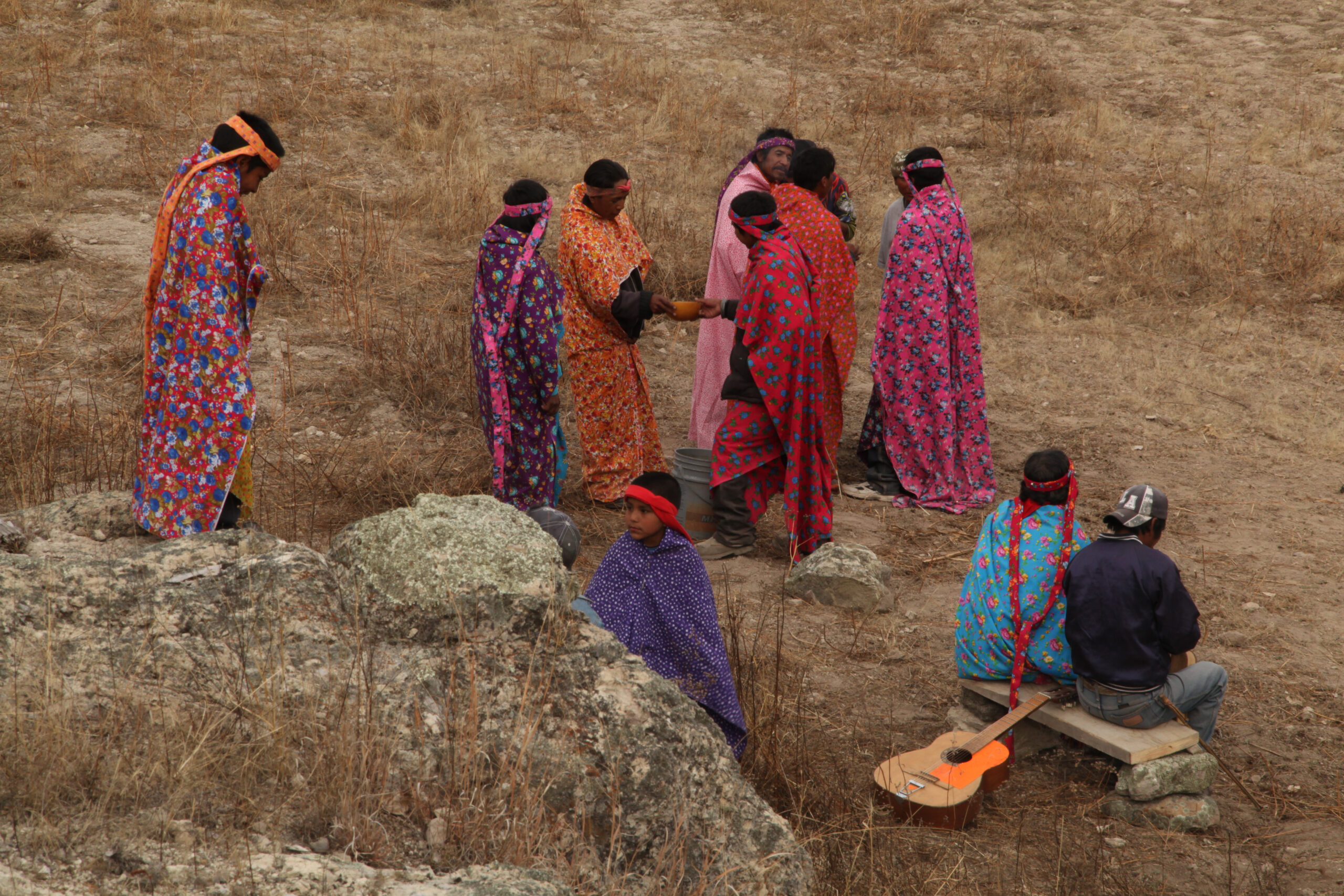
La fin des jeux d’endurance est toujours célébrée par la tegüinada, échange de la boisson de maïs auquel se joignent les danseurs du Matachine. Photo courtesy: Lelio Moehr
The pulse of the “Continent Rouge”
Danzar o Morir, say the Ralámuli.
To dance or to die.
To dance: a collective act to keep life going.
It is from this reality that I created Continent Rouge,17 an immersive image installation connected to a sound journey. A work of Art and Anthropology, to translate and transmit the power of Ralámuli culture as an infinite resource — one fully drawn upon in the service of social inclusion and biodiversity.
What we Western ethnologists call “ritual” or “art”, the Ralámuli call Omàwari — which they translate into Spanish as Fiesta. Rutùburi,18, Hikuri, Yumari, Tesgüino, Matachines, Pintos, Pascual — each Fiesta has its own choreography, its own music, its own season and its own singular purpose. All of them work to repair the world. For the Ralámuli know that ceremonies have the power to transform it.19
During the Omàwari, the Ralámuli transform everyday space into the Awiratzi, the ritual space, which is typically set up in front of the house, between two logs laid on the ground, one to the West and one to the East, where crosses and offerings are placed. The dancers trace spirals and winding lines: ‘The circle we make is not to turn around nothing. It is the circle of the sun, the moon and the seasons. When someone falls ill, it is because their circle has been broken’.
The Ralámuli dance long, ecstatic refrains from dusk to dawn, sustaining the cosmic unity that binds day to night and the individual to the community. The figures of Onorùame, the father-sun, and Eyerùame, the mother-moon, govern the rhythm of harvests and ceremonies, reaching far beyond Rioshi, the Catholic ‘God the Father’.
The Owirùame — healer, curandero — and the Sipaàme — raspador, the one who heals with peyote — embody and activate the vitality of the group. The Sawéane, the singer-healer, intones a chant made of vowels, without consonants. Sound is a medicine, just as plant and movement are.
‘Music calls forth what is missing. It closes what has opened. It reunites what has come apart’: so says one of the dancers.
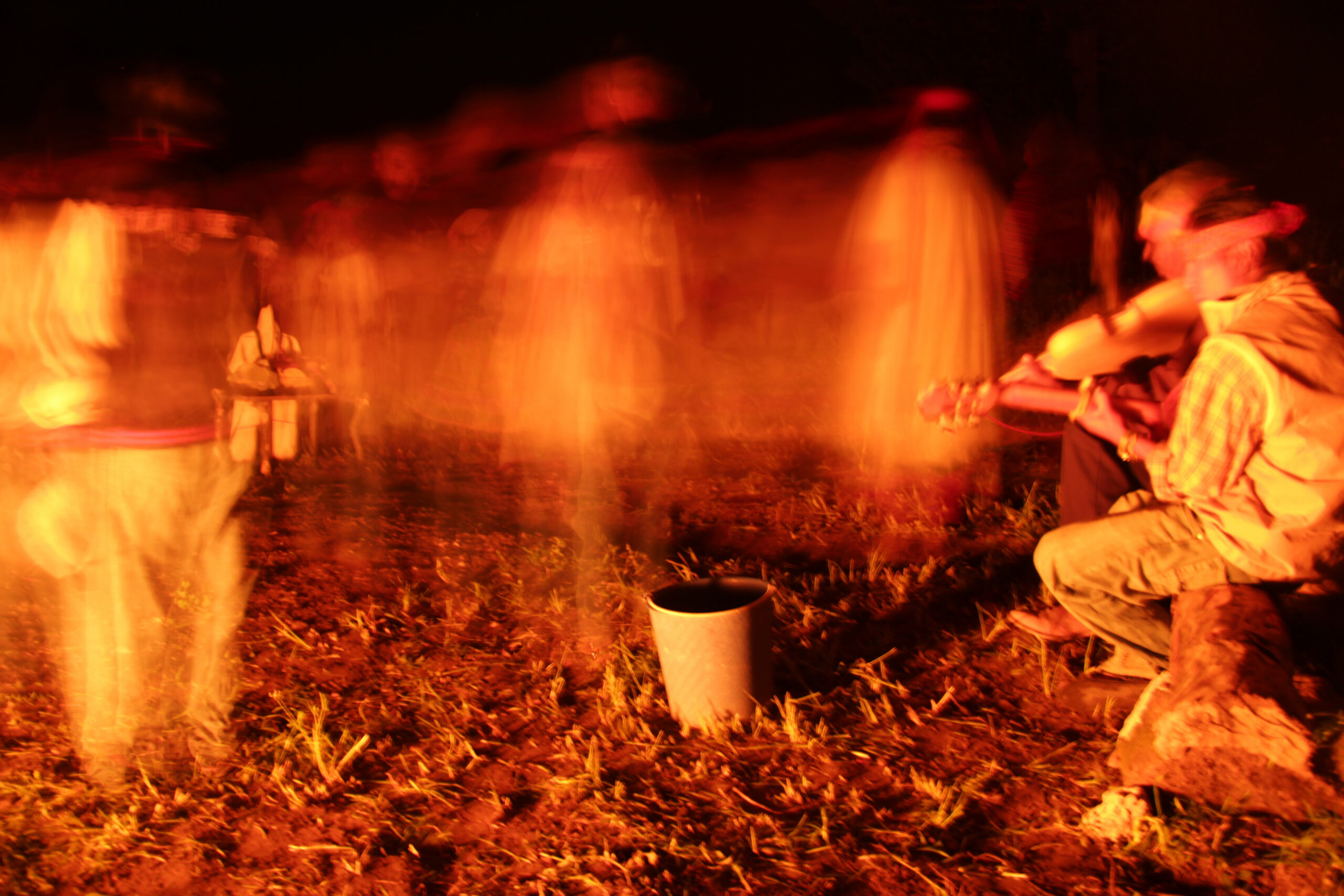
Photo: Sylvie Marchand
… Danzar o morir
Among the Ralámuli I learned that the Sierra Tarahumara is neither a landscape nor a backdrop: it is a living being. The hills are inhabited, the ravines are channels through which forces move, the caves are thresholds, and the wind, the altitude, the sun organise the ritual movements of the people.
Lupita, Modesto, Erasmo, Pancho –– and Artaud too — see a world made of forces, of passages, of the circulation of energies between the human and the non-human.

Photo: Sylvie Marchand
The Ralámuli invite us to reweave the essential bond we have broken in the name of reason, progress and production. Let us listen to them, and rethink our relationship to this planet — not in terms of exploitation, extractivism and domination, but of responsibility and care. So as not to die.
Footnotes & references
[1] See my work: https://gigacircus.net/fr/creations/tsagaan_yavarai, https://gigacircus.net/fr/creations/temps_histoire_pour_compostelle, https://gigacircus.net/fr/creations/amexica_skin
[2] Actor, director, poet and visual artist, Antonin Artaud, was born in Marseille on 4 September 1896, where he is buried. After nine years in psychiatric institutions, he died in Ivry-sur-Seine in 1948.
[3] See Cantar o Morir, Wikarabo Wechiko Mukubo, a 53-minute film directed by Sylvie Marchand. Winner of the Deauville Green Awards 2023. https://www.youtube.com/watch?v=KsSZbWqaNvs&ab_channel=SylvieMarchand
[4] Indigenous linguists and anthropologists in Chihuahua are campaigning to reclaim the original name “Ralámuli” (plural: Ralámuli).
[5] Erasmo Palma, poet and composer. https://www.gob.mx/inpi/articulos/erasmo-palma-fernandez-1928-2016
[6] Enrique Alberto Servín Herrera, 1958–2019, at the time head of the Department of Indigenous Languages at the Secretaría de Cultura de Chihuahua. https://enriqueservin.org/
[7] Translated by Martin Makawi, Colección Rayénali, Pialli, Chihuahua, 2014.
[8] Original Spanish version, Mexico y Viaje al país de los Tarahumaras. Out of print. Available as a PDF online.
[9] Antonin Artaud, La Montagne des Signes, in Les Tarahumaras, Folio Essais, pp. 47–52. Written in 1936.
[10] The Theatre of Cruelty: the term Artaud used for the dramatic form he developed in his essay The Theatre and Its Double — revised during the voyage that brought him to Vera Cruz in 1936.
[11] Ibid., p. 144.
[12] Antonin Artaud, Vie et mort de Satan le feu, Arcanes, 1953.
[13] Pour en finir avec le jugement de Dieu: a radio broadcast recorded on 28 November 1947. K éditeur, Paris, 1948. Audio archive: https://www.ubu.com/sound/artaud.html
[14] Chabochis, Mestizos: white and mixed-race non-indigenous people.
[15] See Cantar o Morir: Erasmo Palma speaks these words at the end of the film. https://www.youtube.com/watch?v=KsSZbWqaNvs
[16] https://gigacircus.net/fr/voz_lactea
[17] https://gigacircus.net/fr/creations/continent_rouge
[18] Tutuguri, made famous by Antonin Artaud.
[19] F. L. Bárcenas, A. P. Pintado Cortina (eds.), El sonido del agua: Agua, naturaleza, saberes y oralidad, © El Colegio de San Luis, 2024. Available as a PDF online. (A rich compilation of rituals analysed by indigenous researchers.)
Recent articles
Walking through places generates mental images we carry with us: glimpses of where we were and what we did. But can we be sure of that? Think of the image you carry of a place you’ve walked: its colours, how it unfolded, its texture, its sound. Always slipping, always being… Read more »
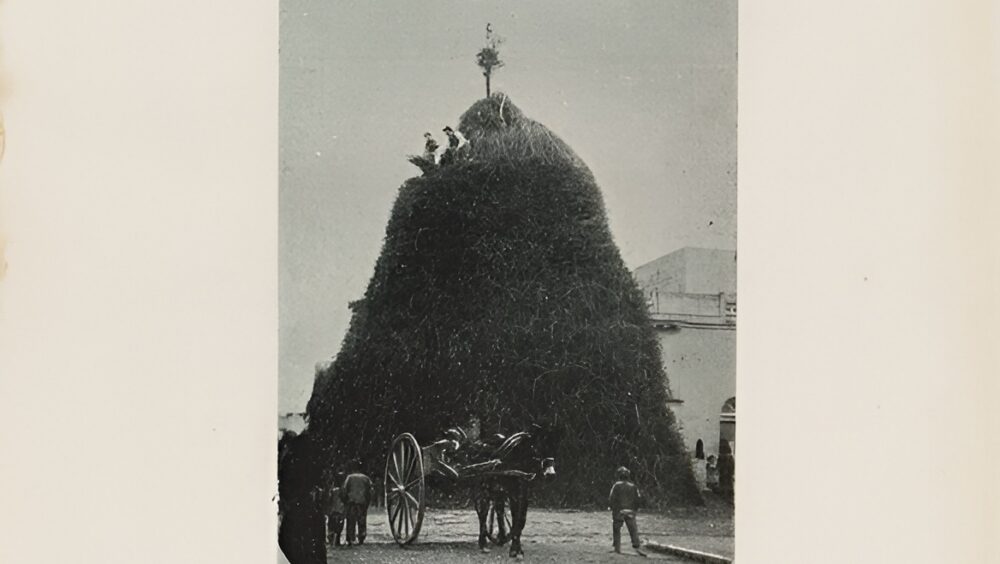
Known as Fòcara (from the Latin focus, meaning “fire”) in the Salento dialect of Southern Italy, the Fires of Saint Anthony in Novoli is a colossal bonfire lit annually in honor of Saint Anthony the Abbot, patron saint of animals. In this section of the Past Present Archive, we publish… Read more »
Unfolding through the city of Guimarães, Portugal, The Walking Body is an artistic research programme that explores collective walking as a methodology for situated knowledge, creative inquiry and engagement with place. Taking place across three consecutive editions (2024–2026), the programme has generated a range of artistic outputs: from drawings to… Read more »