

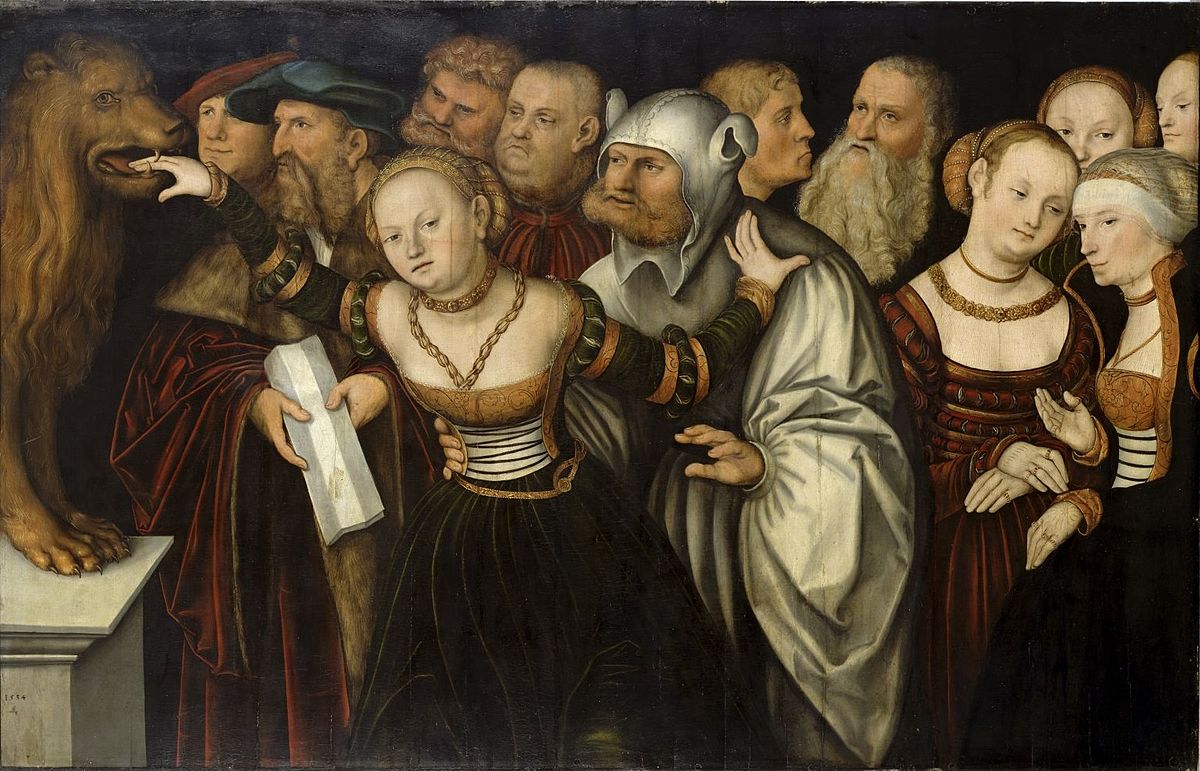
Mouth of truth
More than just a large male marble face near the heart of Rome, the Bocca della Verità is above all a medieval legend about the existence of a statue that would bite the hand of anyone who lied while placing it inside. This 1891 text was written by Ersilia Caetani Lovatelli, one of the rare female archaeologists and antiquities scholars in Italian society at the time. After lamenting public indifference to the curious Roman object, Lovatelli traces its transformation from manhole cover for wastewater drainage, to agentive sculpture capable of revealing the truth. Central to her analysis is the paradox of equivocal oaths: how clever individuals defeat such tests through technically truthful statements that deliberately deceive. Today, the Bocca is a tourist attraction, with thousands of tourists every year repeating and photographing the same centuries-old gesture. This translation preserves the original text in full, but we have added images from art history and popular culture to accompany it.
Nusquam minus Roma cognoscitur, quam Romae! [Nowhere is Rome less known than in Rome!]. Thus wrote Petrarch about five centuries ago in a letter to Giovanni Colonna;1 but if he were to come back to life he could repeat the same today, given that only a few know the history of our ancient monuments and the different transformations they experienced over the centuries.
Indeed I must say, and not without a certain feeling of regret, that for most people the study of antiquity and archaeological disciplines are synonymous with something serious and tedious, especially when dealing with less remarkable monuments, whether from the perspective of history or of art. I am convinced that very few who visit the ancient and beautiful church of Santa Maria in Cosmedin, pausing briefly in its little portico to admire the great marble mask housed there, commonly known as the Bocca della Verità [Mouth of Truth],2 know its original purpose or the curious legend associated with it.
Before going further, I believe it useful to say a few words about the aforementioned church. We don’t know exactly when it was built, nor which ancient temple’s ruins it stands upon – whether the temple of Patriarchal Pudicitia or the temple of Ceres, Proserpina, and Iacchus. But however that may be, we know the church held the rank of diaconia from early on.

Anonymous. Santa Maria in Cosmedin, in Piazza Bocca della Verità, Rome, 1875 – 1896. Source: Lombardia Beni Culturali.
Duchesne3 has clearly shown that diaconias, established in the late seventh century after paganism and the ancient world had ceased to exist, were largely situated in the center of the city. They arose on the sites of ancient public buildings – when they weren’t themselves former public buildings converted into churches. This contrasts with the presbyterial titles, which were founded when paganism still dominated Rome and were located in remote areas, far from the city center, the Capitoline, and the Forum.
The church of Santa Maria was first called ‘in Schola Graeca’ – a name that, according to general belief, came from a Greek confraternity (schola) residing there.4 The memory of this community persists in the present-day nearby street called della Greca. And since the Greek congregation owned not only the church but also the surrounding territory, which was likewise called Schola Graecorum. In the tenth century, that entire stretch of the Tiber’s bank came to be known as Ripa Graeca.
However, Costantino Corvisieri, a highly learned and authoritative scholar of the Middle Ages, is instead of the opinion that the denomination of Schola Graeca that the name Schola Graeca derived simply from the presence of a military garrison stationed at the foot of the Palatine, tasked with honoring and defending the Eastern emperors and their representative dukes. We find a similar usage with the exarchs of Ravenna, where Schola Graeca also means ‘military garrison.’5
Given that Greeks inhabited the area, Corvisieri does not exclude the possibility that a Greek school existed there either. He simply doesn’t believe the district’s name came from this school, especially since the word schola was commonly used to mean a military unit, as we know from writers before the tenth century.
Here I should mention in passing that the basilica of San Giorgio in Velabro, located near Santa Maria in Cosmedin and dedicated to the Greek church’s most popular martyr, was built when a Byzantine duke governed Rome. The Greeks greatly honored and frequented this church, even though it was not the seat of the aforementioned schola.
They nevertheless loved to be buried there, treating it as a place of their own. This is evident from several Byzantine-era Greek inscriptions found there. These inscriptions show not only that those buried in San Giorgio in Velabro belonged to Rome’s Greek colony – a community that included men well-versed in letters – but also that the colony had its own clergy, who likely served the church in the late ninth century.6
Now, returning to the church of Santa Maria, the name ‘in Cosmedin’ – which means ‘well-adorned’ – was not added until after Pope Adrian I rebuilt it. The name came precisely from the many rich ornaments he used to embellish the church, though its complete renovation didn’t happen until the reign of Callistus II and his successors.
The so-called Bocca della Verità is located in the portico of this ancient church – a precious jewel of medieval art – on the left as you enter. Canon Placidi transported it there in 1632; before then, it was mounted on the portico’s façade wall that faces the Marmorata.

The mouth of truth in Rome
It consists of a round disk7 in pavonazzetto marble, on which a large human face has been skilfully carved in relief. From its rich, curled hair emerge what appear to be either crab pincers or, as others believe, small ram’s horns – a detail difficult to discern because the marble is quite worn and corroded by time.
I cannot accept this latter theory, however, because the effigy undoubtedly represents a marine deity, as I will shortly explain, and therefore crab or crayfish pincers suit it far better than ram’s horns. The sculpture is broken in two pieces, but the nail holes that once fastened it to its original location are still visible on the sides.
As for its use, judgments have varied considerably, some of which are better characterised as fables or legends. From ancient times, ordinary people called it a simulacrum of Jupiter Ammon set upon that god’s altar, before which perjurers were brought to be discovered – for if they had sworn falsely, they would be unable to withdraw their hand from the fatal mouth. Hence the name Bocca della Verità, which it retains to this day.
An inscription installed in 1632 states that it served for oath-taking by placing one’s right hand into its open mouth. This superstitious belief (which may have been merely a distorted tradition of the ancient Roman practice of swearing oaths at the nearby Ara Maxima) appears, though somewhat altered, in the Mirabilia, where it is said that the marble mouth issued responses and oracles. The name Bocca della Verità itself dates to the Middle Ages.
Some scholars, meanwhile, set aside the fantastic veil of legend and began to study the ancient effigy carefully, gradually approaching the truth. Some judged it to be a water receptacle for a temple open to the sky, such as the Pantheon; others thought it a fountain outlet; still others simply a sewer mouth. Winckelmann, identifying it as an image of Oceanus because of the two branches adorning its forehead – a special attribute of that deity – argued that when placed in the center of a square, it would have collected rainwater through the holes of the mouth, nostrils, and eyes, channeling it into the adjacent sewers.
Eventually, Visconti hit the mark.8 A passage from Propertius9 describes disks carved with triton images, set into the pavement of public places, received water from nearby fountains or from streams running through neighbouring streets during rain, mainly through the mouth’s holes. Visconti concluded that the Bocca della Verità was simply one of these disks that the poet mentions. Positioned horizontally in squares and bearing triton images, they provided both collection and passage for the waters:
Quum subito Triton ore recondit aquam. [When suddenly the Triton swallows the water through his mouth.]
I should mention that this marble caught the attention of Edmond About during his visit to Rome and its monuments. He left a description of it – somewhere between burlesque and serious – in his Rome Contemporaine.10
But now it’s time to present the legendary tale of the Bocca della Verità – the story that the fervent medieval imagination connected to the gentle Mantuan poet [Virgil], who in that age was held to be a magician and enchanter.11
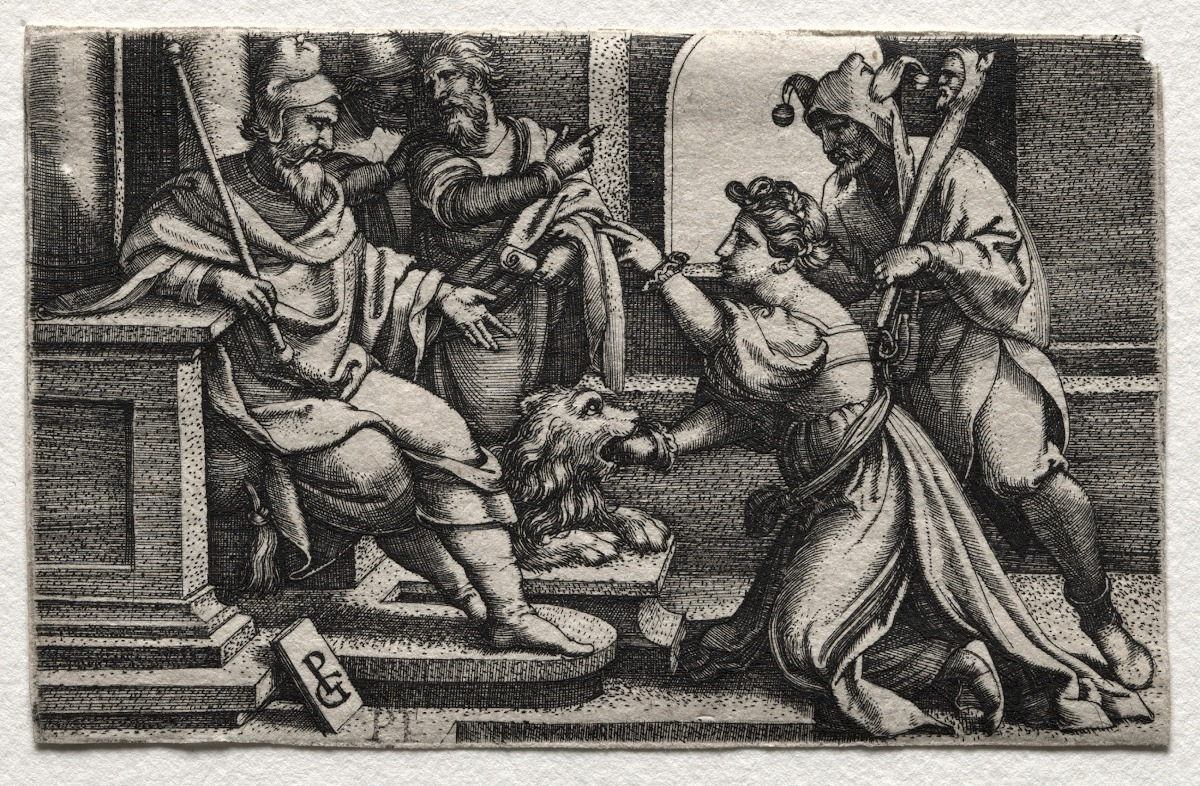
George Pencz, The Mouth of Truth, ca. 1534-35. Engraving. Source: Cleveland Museum of Art.
According to the legend, Virgil had made in Rome a marble face with an open mouth, into which those called to testify to their chastity and conjugal fidelity had to place their hand. If they had lied, they wouldn’t have been able to wihtdraw it. A woman carrying on an illicit affair, however, compelled by her suspicious husband to prove herself through this test, astutely devised a way to render it useless. This is what she did.
She told her lover to pretend to be insane and encounter her by chance at the place where the oath would be taken. Upon seeing her appear, he was to run up playfully and embrace her immediately. This was executed to the letter, but since he was considered mad, no one thought it strange. The woman then swore, feigning distress, that she had never been embraced by any man except her husband and that poor madman. Since this was the literal truth, her hand emerged unscathed from the test.
But Virgil, from whom nothing could be hidden, was forced to confess that women were far more cunning than he; and from that day forward the marble effigy lost its portentous power. This witty tale, which undoubtedly enjoyed a certain fame, was once painted on a house opposite the church of Santa Maria Egiziaca, now completely destroyed.12
So it seems the Romans weren’t the ones who connected Virgil to this legend – in fact, the story appears to have been unknown in twelfth-century Rome. What did circulate among common people was the belief that ancient Romans swearing oaths would put their hand in the effigy’s mouth, which would bite any liar who tried the test. The tale claimed this power lasted until a clever adulteress suddenly made it stop.
One should note, however, that this legend – which we find repeated in certain Indian tales, albeit with variations, and which circulated in Europe independent of Virgil’s name – was known from ancient times, as the following anecdote from Macrobius attests.
A certain Tremellius, while he was peacefully amusing himself in the countryside, had his slaves seize and kill a sow that had shortly earlier escaped from a neighbour, who, becoming aware of the matter and fearing that it had been stolen from him, had his people surround Tremellius’s house, at the same time demanding that he immediately return the animal to him.
But Tremellius, having been fully informed by his slaves, sought to avoid the danger. He hastily concealed the sow’s skin in the bed where his wife lay, then permitted the neighbour to conduct his search. Upon reaching the bedroom, Tremellius solemnly swore that no other sow could be found in his house except the one lying there under the covers. As he said this, pointing to his wife, he made it appear he meant only her. This witty and cunning oath earned Tremellius the nickname ‘Scrofa’,13 which then passed to his descendants.14
Apart from the romantic element, anyone can see the striking similarity between this anecdote and the Bocca della Verità legend.As I mentioned earlier, this legend circulated throughout Europe independently of Virgil’s name. The oldest known text associating it with the Augustan poet is an anonymous German prose from the first half of the fourteenth century, entitled Of an effigy in Rome that tore with its teeth the fingers of adulterous women.15 It is natural that, once it reached Rome, the fabulous tale would become connected with the marble face of Santa Maria in Cosmedin. While the French romance Virgilius transforms the effigy into a bronze serpent that bites perjurers and liars, the Dialoghi ameni16 preserves the marble face version, matching the legend that later circulated in Rome.
I could provide many more examples of images that, in the superstitious Middle Ages full of fables and marvels, were believed to possess the marvellous power to reveal others’ faults, but I intend to return to this topic on another occasion. For now, I will mention only two: a certain statue described by the Byzantine writer Codinus,17 which had four horns and would spin around three times if approached by a man whose wife was unfaithful; and an ancient bridge where, at the ring of a small bell, only those faithful to their marriage vows could remain standing. The bridge was said to have been purposely constructed by Virgil through his magical arts to comfort an unfortunate man whose wife had betrayed him, thereby demonstrating how numerous were his fellow sufferers. To these two examples I shall add another: a portentous statue of Venus that made immodest women suddenly appear naked in the sight of all.18

Audrey Hepburn and Gregory Peck in ‘Roman Holidays’ (1953), by William Wyler.
As for the Bocca della Verità itself, I should mention that it appears in a description of Rome written for the 1450 Jubilee, which says: ‘A millstone-like round stone, with a face carved in it and called the stone of truth, which in ancient times had the power to reveal when a woman had wronged her husband.’19 This superstition seems to have continued to perdure among the people even two centuries later, when it was claimed that if an unfaithful wife had thrust her hand into that gaping mouth, it would have immediately closed.20
In any case, this marble, known for several centuries as the Bocca della Verità, would be of little importance on it own, except for one thing: its being tied to one of the most curious episodes in the medieval legend that transformed the gentlest Roman poet [Virgil] into a magician and sorcerer.
Footnotes & references
[1] Book VI of the Familiar Letters, letter 2
[2] See Ficoroni, Le Vestigia di Roma antica, p. 25, which provides the drawing; and Von Duhn, Antike Bildwerke, III, p. 82, which cites the authors who have spoken of it.
[3] Notes sur la topografie de Rome au moyen àge, II ; Les titres presbytériaux et les diaconies. [Trans. note: Diaconias were charitable institutions administered by deacons in early medieval Rome, serving as both churches and welfare centers distributing aid to the poor.]
[4] It is the opinion of some, but I truly do not know how well supported by good reasons, that Saint Augustine, during his stay in Rome, taught rhetoric there.
[5] A Schola Graeca is mentioned in Ravenna in the sixth century. Marini, Pap. n. CXX, 185: Leonti Medici ab Schola Graeca.
[6] See Batiffol, in Mélanges de l’École Française, 1887, pag. 419-91
[7] Measurement of the circumference: 1m., 70. Von Duhn, Antike Bildwerke, III, p. 82, claims that it offers a certain similarity with the face of the Jupiter of Otricoli.
[8] Mus. Pio clem. VI, p. 52. [This probably refers to the catalogue of the Pio-Clementine Museum, Volume VI, page 52]
[9] II, 82
[10] « Cette Bouche-de-Verité est une curieuse relique du moyen àge. Elle servait aux jugements de Dieu. Figurez-vous une meule de moulin qui ressemble, non pas à un visage humain, mais au visage de la lune ; on y distingue des yeux, un nez et une bouche ouverte où l’accuse mettait la main pour prèter serment. Cette bouche mordait les menteurs ; ai moins la tradition l’assure. J’y ai introduit ma dextre en disant que le Ghetto était un lieu de déliccs, et je n’ai pas été mordu». [This Mouth-of-Truth is a curious relic of the Middle Ages. It served for trials by ordeal. Picture a millstone that resembles, not a human face, but the face of the moon; one can distinguish eyes, a nose, and an open mouth where the accused placed his hand to swear an oath. This mouth bit liars; at least tradition assures it. I introduced my right hand into it saying that the Ghetto was a place of delights, and I was not bitten.]
[11] See especially Comparetti, Virgilio nel medio evo, and the sources cited therein.
[12] Platner, etc., Beschr. Roms, III, 1, p. 382. [Trans. note: “Beschr. Roms” = abbreviation of “Beschreibung Roms” (Description of Rome) in German]
[13] Saturn. I, 6, 30.
[14] According to others instead, this nickname would have come to the Tremellian family from a Tremellius who was quaestor in Macedonia in the year 142 BC, who in the absence of A. Licinius Nerva, propraetor of that province, destroyed a pseudo-Perseus or a pseudo-Philip and an army of sixteen thousand men. It is claimed that in assaulting the enemies he said that he would scatter them ‘ut scrofa porcos’ [like a sow scatters piglets], whence the nickname of Scrofa to him and to his descendants.
[15] See Comparetti, Virgilio nel medio evo, II, p. 122
[16] See Genthe, Vita e memoria durevole di Virgilio poeta e mago p. 75 ‘…Virgil has made in Rome an image, and there those who swear oaths are put to the test. And there the man must place his hand inside the mouth. If one has sworn falsely, the face bites off his hand. [We have been unable to identify the specific work referred to as Dialoghi ameni.]
[17] Codinus, De aedificiis Constantinopolitanis, p. 119.
[18] Codinus, De signis Constantinopolitanis, p. 50-1.
[19] Archivio della Società Romana di Storia Patria, IV, p. 580.
[20] Berchenmeyer, Le Curieux antiquaire, Leide, Pierre Vander Aa, 1729; I, p. 294 « …un Marbré qui représente une téte, la bouche ouverte, et les bonnes gens disent, que si une femme infidèle à son mari y mettoit la main, cette bouche se fermeroit ». [..a Marble that represents a head, the mouth open, and the good people say that if a woman unfaithful to her husband put her hand in it, this mouth would close.’] Some falsely believed that this effigy was that of Pallor or Terror venerated in Rome. See Venuti, Descrizione Topografica delle Antichità di Roma, II, p. 28. The satirical poet Gioacchino Belli made the Bocca della Verità the subject of one of his sonnets. Morandi Editor, II, p. 194
______
Translated chapter from Ersilia Cetani Lovatelli’s Miscellanea archeologica, Roma, Tip. della R. Accad. dei Lincei, 1891. Available (Italian only) here: https://archive.org/details/miscellaneaarch00lovagoog/page/n5/mode/2up [last accessed 9 January 2026]
______
Opening image: The Mouth of Truth, by Lucas Cranach the Elder, oil on bench wood, 1514
Recent articles
Walking through places generates mental images we carry with us: glimpses of where we were and what we did. But can we be sure of that? Think of the image you carry of a place you’ve walked: its colours, how it unfolded, its texture, its sound. Always slipping, always being… Read more »
Known as Fòcara (from the Latin focus, meaning “fire”) in the Salento dialect of Southern Italy, the Fires of Saint Anthony in Novoli is a colossal bonfire lit annually in honor of Saint Anthony the Abbot, patron saint of animals. In this section of the Past Present Archive, we publish… Read more »
Unfolding through the city of Guimarães, Portugal, The Walking Body is an artistic research programme that explores collective walking as a methodology for situated knowledge, creative inquiry and engagement with place. Taking place across three consecutive editions (2024–2026), the programme has generated a range of artistic outputs: from drawings to… Read more »