
Walking Images into Place: WAC Encounters and the Anima of Prespa
In summer 2025, for one entire week, walking became the defining activity in Prespa, a mountainous transboundary landscape where two ancient freshwater lakes traverse Greece, Albania, and North Macedonia. Through acts of healing, experiencing, resisting and becoming, WAC 25 explored walking as a multifaceted practice as part of the wider, four-year Creative Europe project “Walking Arts & Local Communities” (WALC), launched in January 2024 by the International Center for Artistic Research and Practice of Walking Arts. With this overview of WAC 25 written by researcher Katerina Pistola, we are honoured to present the first of a series of contributions following WALC’s many events and workshops.
Walking as Image, Walking as Place
As anthropologist Sarah Pink reminds us, ‘places are not bounded containers but are constituted through sensory relations, movement, and practice’.1 Such perspectives shift attention toward imagining worlds that are not constructed solely through representation or narrative, but through embodied practices that entangle perception, memory, and movement.
Walking—understood as an artistic, social, and political act—functions as a generative image-making process through which places are continually produced, negotiated, and reconfigured. The International Prespa Walking Arts Encounters 2025 (WAC 25), organised around the theme Walking Home and Walking in Transition, offered a situated constellation of such practices in a borderland marked by layered histories of displacement, coexistence, and return.
Prespa, a geographical region straddling the three nations of Albania, Greece, and North Macedonia, is an accumulation of lived images rather than a static site: lakes shaped by memory, paths sedimented with political histories, villages bearing traces of migration, war, and loss. These landscapes operate simultaneously as material environments and as repositories of social imagination. The walkshops implemented during WAC 25 activated these latent images not by representing place from a distance, but by inhabiting it through temporary, embodied engagement—often in collaboration with local residents.
Walking here functioned as what Tim Ingold describes as a process of ‘knowing from the inside’,2 where movement generates meaning through continual engagement with the environment. These encounters can be read as experiments in place-making through embodied images—images that do not merely depict place but occur within it, occupying participants as their living medium and mediating between personal memory and collective imaginaries.
This article reflects on selected WAC 25 walkshops as practices of place-making through movement. Walking is approached in multiple ways: as manifesto, feast, resistance, healing, return, and play—each a mode of producing images in place rather than representations of place. These embodied practices were accompanied by academic presentations and discussions during the WAC 25 conference, where artists, researchers, and practitioners reflected on walking as artistic research, social practice, and situated methodology within broader theoretical and political frameworks.
Within contemporary art discourse, walking has become a widespread practice that operates in at least two distinct yet overlapping ways: as a mode of experiencing environment and body from which artworks may emerge (the art of walking), and as an autonomous artistic medium that initiates works defined through the act of walking itself (walking art). WAC 25 operated precisely within this overlap, allowing practice and theory to inform one another through situated experience.

Great Prespa Lake Photo by drone: Christos Ioannidis
Walking as a Feast: Sensory Abundance and Collective Attention
Walking as a feast proposes movement as an act of collective nourishment—sensory, affective, and relational. Rather than focusing on outcomes or destinations, this approach emphasises shared attention, slowness, and attunement as core values. Interdisciplinary artist and scholar Ellen Mueller describes walking as an artistic practice that ‘creates conditions for attention, care, and relational exchange’, rather than producing discrete objects.3
In Prespa, walking unfolded as an accumulation of sensory impressions: the crunch of gravel paths underfoot, shifting reflections across the lake surface, the smell of vegetation warmed by the sun, the rhythm of breath synchronised with pace. These sensations accumulated as a distributed image held collectively rather than individually.
This mode of walking resisted extractive or consumptive approaches to place. Instead, it aligned with what professor Maggie O’Neill identifies as walking’s capacity to generate ‘empathetic and embodied forms of knowing’, particularly in socially and historically complex landscapes.4 Walking-as-feast cultivated a temporary common of perception, where meaning emerged through shared presence rather than interpretation alone.
The image of Prespa was thus not encountered as a pre-existing representation but as a lived, unfolding process shaped by attentiveness, reciprocity, and care, leaving no discrete object behind, only a shared, embodied experience.
Walking Manifestos: Declaring Movement as Method
Walking manifestos at Prespa’s Encounters were enacted positions rather than written declarations. These practices asserted walking as a critical methodology that privileges slowness, uncertainty, and situated knowledge. Mueller frames such approaches as a refusal of spectacle in favour of durational engagement, where the artwork is inseparable from the act of walking itself.5
In this sense, walking manifestos functioned as visual statements articulated through form rather than language. Routes, pauses, collective decision-making, and moments of silence became legible markers of alternative ways of inhabiting space. As Ingold argues, movement is not a means of connecting pre-existing points, but a way of becoming with the world.6 The manifestos produced images that were neither monumental nor fixed, but inscribed in a visual culture grounded in action, attention, and process.
Walking manifestos at WAC 25 also foregrounded attentiveness to ecological relations and ethical modes of exchange. Walking here was not only a declaration of method but a commitment to reciprocity with the more-than-human world. This expanded the manifesto form beyond human politics, situating walking as a negotiation between bodies, landscapes, and seasonal rhythms.
Within this frame, the walkshop Through the Eyes of Foragers: Gift-Gathering, led by Lydia Matthews, unfolded as a collective foraging walk accompanied by local collaborators deeply attuned to Prespa’s ecology: Nikos Giannakis, Nikos Tsilis, and Tsilis’ hound dogs. Moving through a sacred grove of rare juniper trees on Mt. Devas, participants learned to read soil, climate, and seasonal indicators while searching for wild edibles and medicinal plants.
Prompted by shared activities, the walkshop framed foraging through what Robin Wall Kimmerer describes as the ethics of reciprocity inherent in a gift economy—recasting walking as an act of care, gratitude, and responsibility.
Walking Beyond Boundaries: Community into Being
In Prespa—a region historically shaped by shifting borders—walking beyond boundaries activated the landscape as a social image of division and connection. Walking became a way to rehearse alternative forms of belonging, where community emerged through co-presence rather than identity. This aligns with artist Ernesto Pujol’s conception of walking art as a ‘socially engaged path’, where ethical relations are produced through sustained co-presence rather than symbolic gestures.7
Leslie Salzinger’s walkshop Walking Community into Being proposed walking as a process through which a temporary trans-national counter-public might emerge. Moving together through border landscapes, participants encountered the visible and invisible infrastructures that organise belonging and exclusion. Morag Rose’s feminist walking practice offers a useful lens here, emphasising walking as a means of exposing how power operates spatially while simultaneously creating space for collective resistance.8
Walking beyond boundaries at WAC 25 also took poetic and pluriversal forms, foregrounding relationality across cultural, geographic, and political differences. These practices proposed walking as a means of weaving connections rather than crossing lines. This approach was embodied in Co-border Interweavings, by Patricia Miranda, Molly Wagner, Sofia Antonakaki, and Anni Kaltsidou.
Four women from different parts of the world walked together through the Prespa borderlands, gathering branches, wild plants, and flowers. From these materials they wove interconnected wreaths, later released onto the lake at the tri-national meeting point. Drifting across the water, the wreaths formed a fragile yet resilient image of entanglement, articulating walking as a practice of coexistence and good neighbourliness.
Walking as Resistance
Walking as resistance at WAC 25 foregrounded movement as a means of unsettling dominant symbols, narratives, and spatial orders. Syn Glyphs’ Walking Ritual, led by Kate Quarfordt, explored walking as both resistance and healing through choreographed movement and flags printed with photographic “Sun Glyphs” — ephemeral patterns of reflected light captured in urban space.
By replacing nationalist banners with these fluid light-images, participants substituted fixed emblems of identity with forms that shifted, dissolved, and resisted symbolic ownership. Artist and scholar Karen O’Rourke’s discussion of walking and mapping as artistic practices is particularly relevant here, framing such acts as counter-cartographic—challenging dominant spatial narratives through embodied re-mapping.9
Light functioned as a relational image, impossible to own, claim, or stabilise. The procession rejected hierarchical formation in favour of fluid, collaborative movement. As Ingold suggests, lines traced through walking are not boundaries but paths of becoming.10
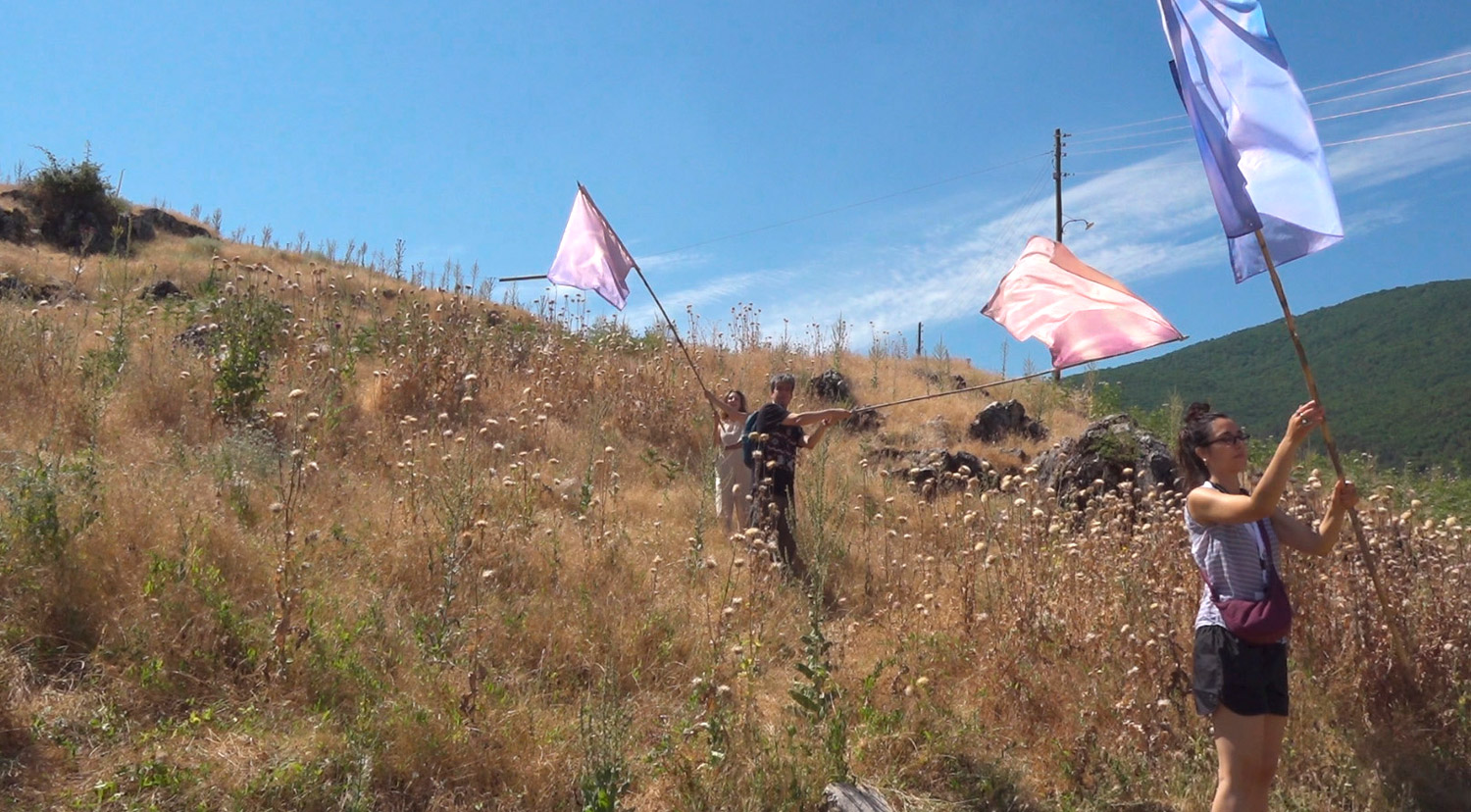
Sun Glyphs: A Walking Ritual by Kate Quarfordt photo: Christos Ioannidis
Walking as Healing
Walking as healing at WAC 25 approached care not as a destination but as a shared, processual practice unfolding through movement. As O’Neill highlights, walking can function as a methodological tool for healing when it foregrounds care, reflexivity, and shared vulnerability.11 Palomar, conceived by Dimitra Nikolopoulou, unfolded as a guided nighttime walking meditation on the island of Agios Achilleios.
Darkness recalibrated perception, intensifying sound, touch, and internal imagery. Participants engaged with activated scores that invited attentiveness and reflection, culminating in a collectively authored self-care walking guide. Healing here was framed as the formation of an ephemeral community rather than individual recovery.
The night landscape acted as a mirror for internal states, while walking provided a rhythm for collective grounding. The images produced persisted beyond the walk as affective traces, shaping how participants carried the place within them.
Walking Home: Return, Memory, and the Weight of History
Walking home at WAC 25 foregrounded return as an embodied negotiation with memory, history, and belonging. As Pujol argues, socially engaged walking practices can function as acts of ethical witnessing, where attention itself becomes a political gesture.12 To the Homeland, proposed by the DOMUM collective,13 addressed walking as return shaped by historical trauma.
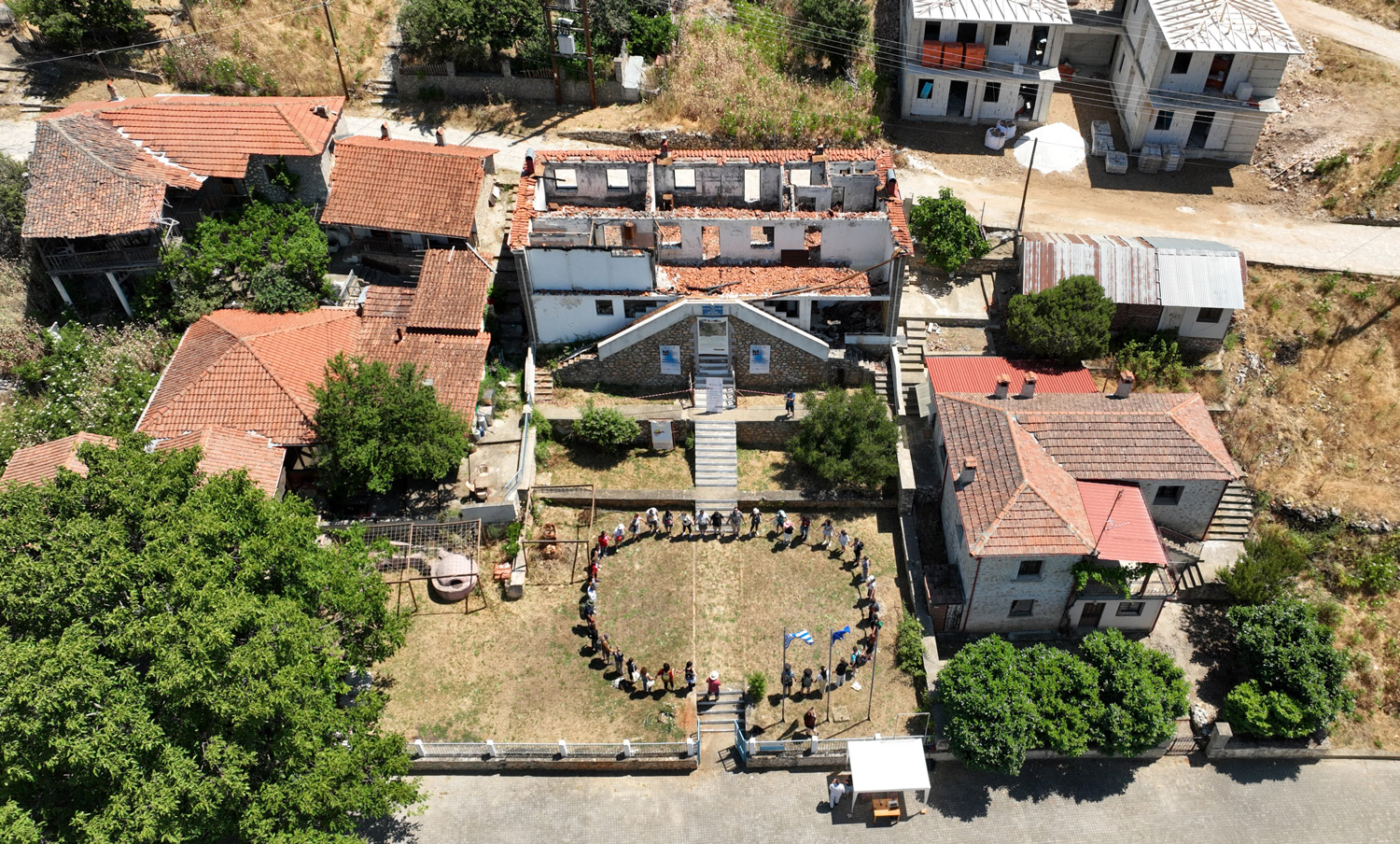
The symbolic march from the borders of Laimos to Psarades retraced forced displacements during the Greek Civil War. Drawing on testimony from a returned child refugee, the walk transformed the landscape into a mnemonic device, embedding absence, endurance, and loss into Prespa’s terrain. In the context of contemporary migration crises, the walkshop underscored the continued relevance of uprooting and belonging, embedding these themes into Prespa’s terrain.
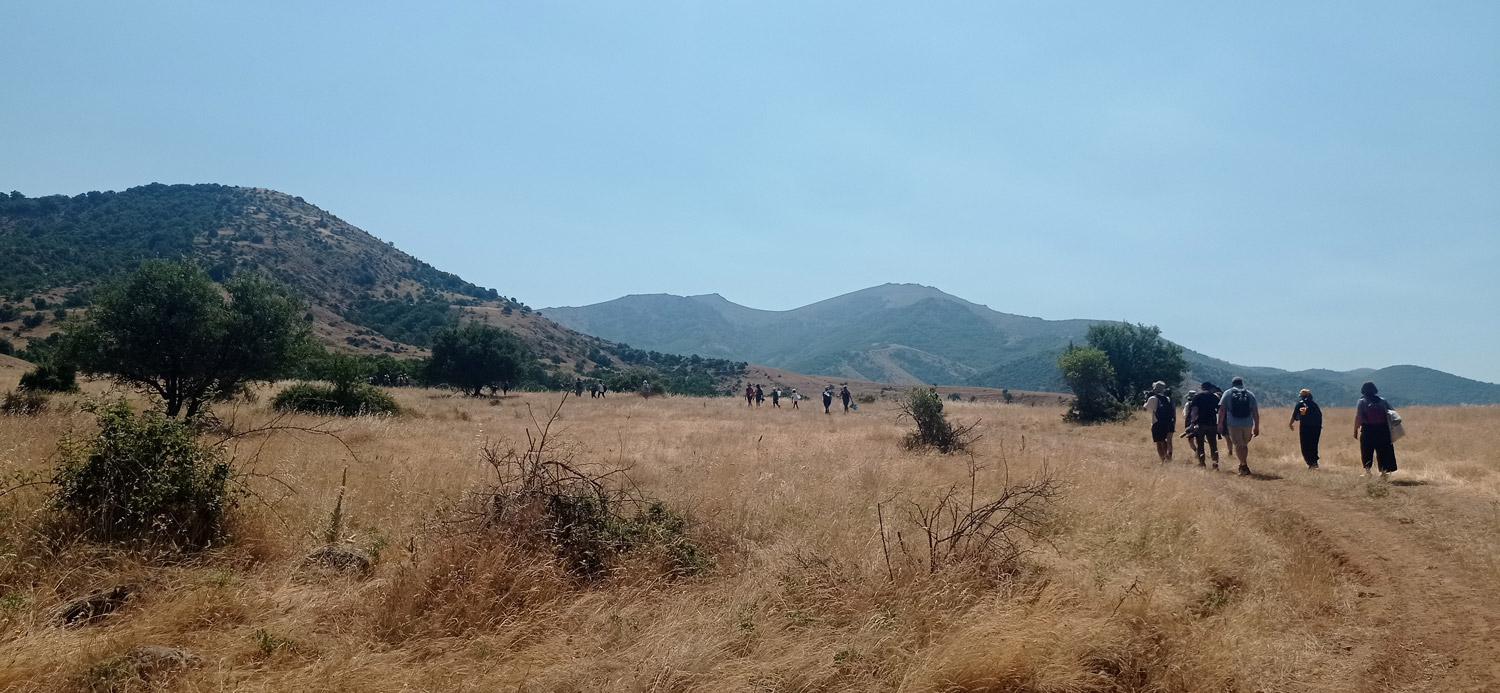
To the homeland in Laimos near Northern Macedonia border by DOMUM collective photo: Katerina Anastasiou
Walking with Children: Play, Empathy, and More-than-Human Relations
Walking with children at WAC 25 foregrounded movement as a formative mode of learning, care, and imagination. These practices approached walking as a way of cultivating attention to others—human and more-than-human—through shared exploration.
Walk & Play: Streetside Games from Around the World, led by Clementine Butler-Gallie, activated walking as playful cultural transmission. Through games embedded in walking, children and adults encountered streets and paths as sites of imagination rather than regulation. As Morag Rose emphasises, joy, care, and play are central to walking practices that resist fear and exclusion in public space.14
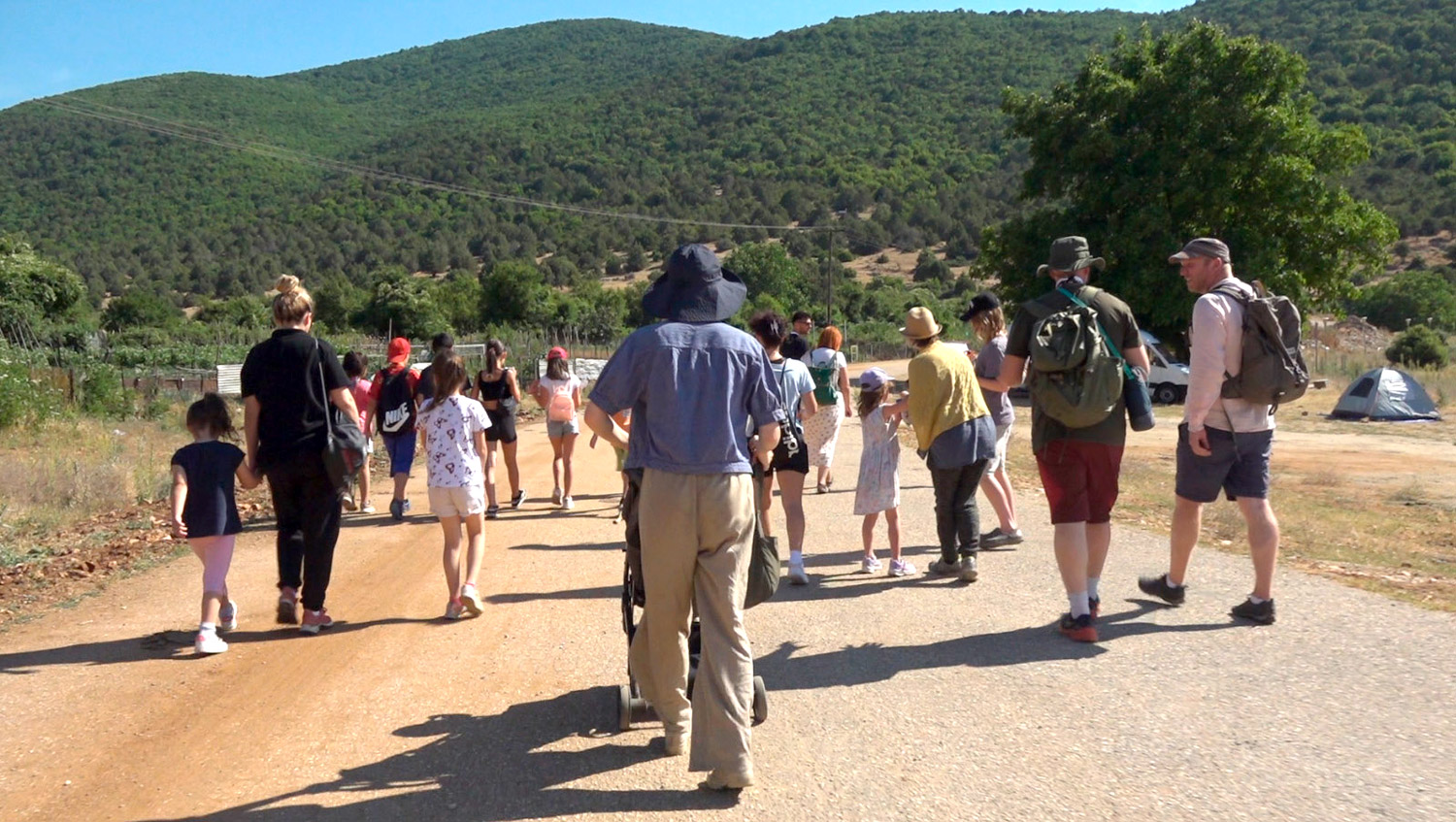
Walking with Children: Following human and bear trace and developing empathy for wildlife by Athanasia Tziona and Konstantinos Zervas photo: Christos Ioannidis
A more ecological approach unfolded in Walking with Children: Following Human and Bear Trace, led by Athanasia Tziona and Konstantinos Zervas. Drawing on the discovery of a poisoned bear’s remains in 2012, the walkshop sought to cultivate empathy for wildlife by enabling children to observe and interact with the symbiosis between human activity and non-human presence. The reconstructed skeleton, housed in the former primary school, operated as an accidental monument—an image that mediates memory, care, and awareness through footprints as conceptual and experiential markers.
Across the Borders led by Kiki Stoumpou, further addressed inclusion, bringing together children with and without disabilities on a shared walk to Cape Roti. Here, the aim was not performance or arrival, but immersion: walking framed borderland space as collective experience rather than division.
Together, these walkshops articulated walking with children as a practice of relational learning. Through play, ecological awareness, and inclusive movement, walking became a means of shaping early understandings of place as something lived with—human and non-human alike—rather than merely observed.
Walking with Locals and Pluriversal Paths
Across WAC 25, walking with locals emphasised situated knowledge and pluriversal perspectives. Again, O’Rourke’s notion of artists as cartographers is instructive here, reframing mapping not as detached, top-down documentation but as a participatory and relational act.15 Walking unfolded through storytelling, ritual, and performative imagination – through which myth and lived history could be reanimated in situ.
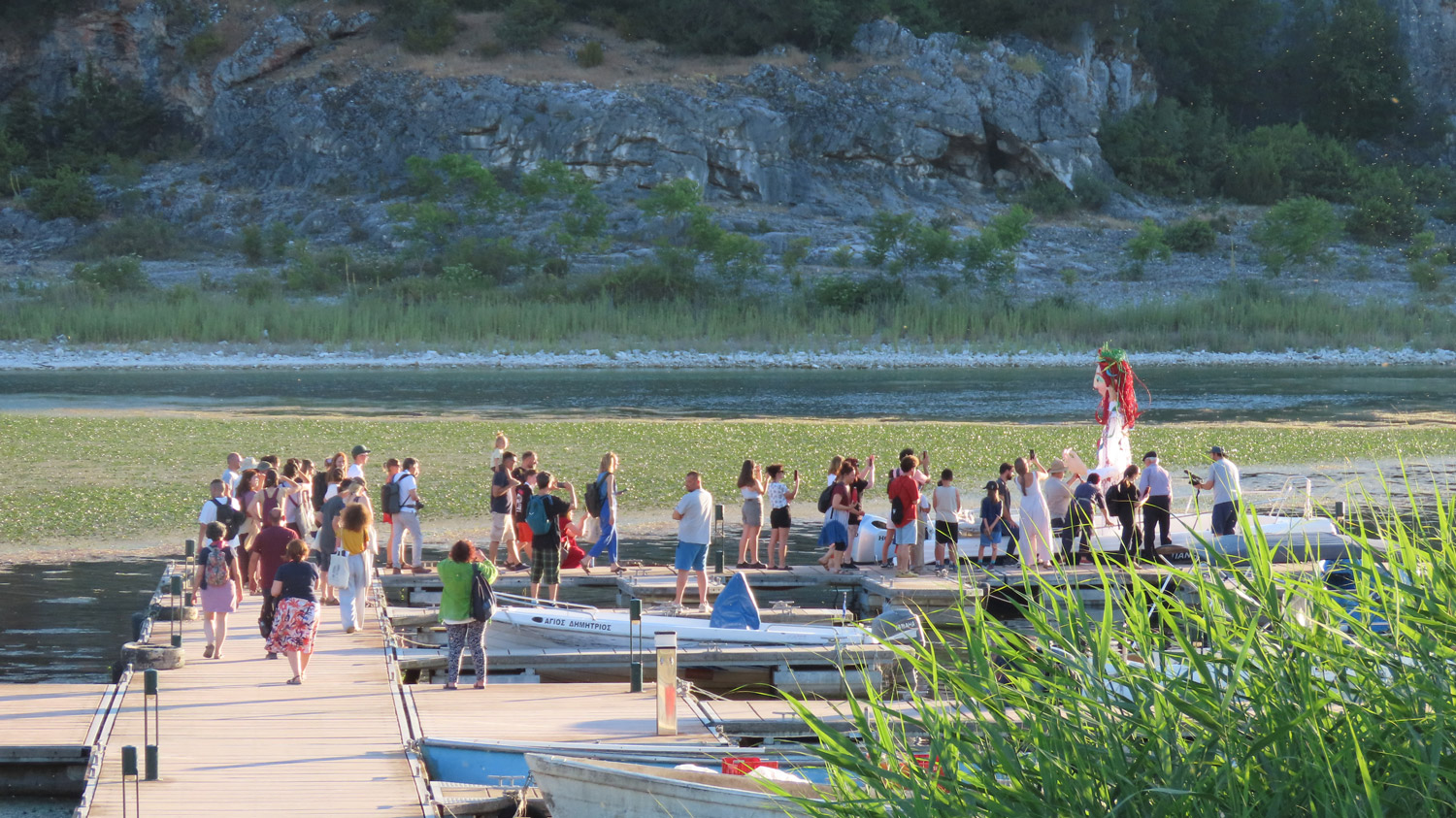
The giant puppet Daseri in Prespes by ART25 Collective photo: ART25
This was exemplified by The Art25 Visual Workshop, where storytelling and puppetry animated Psarades through a walking performance of Daseri, a giant puppet named after a nearby abandoned village sharing her story as a living legend of loss and continuity. Pluriversal walking acknowledged multiple worldviews coexisting within the same landscape, resonating with Ingold’s conception of the world as a meshwork of interwoven lines.16
Walking as a Living Image
The WAC25 Encounters demonstrate walking as a vital image-process. Rather than producing representations of place, these practices generated images in place—embodied, relational, and temporally situated. Walking emerged as a means of activating memory, negotiating history, and opening space for alternative futures through shared movement.
As Ziogas, Sylaiou, and Mendolicchio note, walking art raises questions about whether walking becomes aestheticised when presented or remains narrative memory.17 The practices discussed here suggest a continuum, where images circulate between bodily experience, collective narration, and occasional materialisation.
In Prespa, walking animates the landscape as a living archive. Paths become carriers of testimony, gestures become forms of witnessing, and collective movement allows images to surface that are otherwise dispersed across bodies, narratives, and terrains. These images do not stabilise into monuments or singular accounts; instead, they remain as affective traces, sustained through memory, sensation, and ongoing relationships with place.
Through the integration of walkshops, performances, and academic papers, WAC2518 articulates walking as a research methodology capable of bridging artistic experimentation, anthropological inquiry, and situated local knowledge. At the same time, the encounters reaffirm walking as an artistic and social practice that operates with places, contributing to the ongoing making of Prespa’s anima loci through lived process, shared movement, memory, and care.
Footnotes & references
[1] Pink, S., Doing Sensory Ethnography.
[2] Ingold, T., Being Alive, p. 12.
[3] Mueller, E., Walking as Artistic Practice, p. 28.
[4] O’Neill, M., Walking Methods, p. 41.
[5] Mueller, E., Walking as Artistic Practice, p. 67.
[6] Ingold, T., Being Alive, p. 148.
[7] Pujol, E., ‘Walking Art Practice’, p. 66.
[8] Rose, The Feminist Art of Walking, p. 19.
[9] O’Rourke, Walking and Mapping, p. 4.
[10] Ingold, Being Alive, p. 63.
[11] O’Neill, Walking Methods, p. 112.
[12] Pujol, ‘Walking Art Practice’, p. 69.
[13] The artists of DOMUM are: Katerina Anastasiou, Carla Blasco Aguirre, Leonidas Gelo, Marko Ntemka, Stavroula Chrysopoulidou.
[14] Morag, R., The Feminist Art of Walking, p. 88.
[15] O’Rourke, K., Walking and Mapping, p. 57.
[16] Ingold, T., Being Alive, p. 70.
[17] Ziogas, Sylaiou, and Mendolicchio, ‘Guest Editorial: Walking Art / Walking Aesthetics’, Interartive
[18] The walkshops discussed in this article represent a selected sample of the extensive number of artistic, research-based, and community-oriented walking practices presented during the International Prespa Walking Arts Encounters 2025. The International Prespa Walking Arts Encounters 2025 (WAC25) is organised within the framework of the Creative Europe co-funded project Walking Arts & Local Communities (WALC), running from January 2024 for four years. WALC is initiated by seven partners from five countries: Visual March to Prespes; University of Western Macedonia (Leader, UOWM, Greece); walk · listen · create (Belgium); WalkLab2.PT at the University of Minho (Portugal); Contemporary Art Centre Nau Côclea (Catalonia, Spain); Association Temps Réel (Gigacircus, France); Action Synergy SA (Greece); and School of Gaasbeek (Belgium). Artistic co-ordinators of WALC are Geert Vermeire (WLC) and Yannis Ziogas (UOWM). WALC establishes an international centre for artistic research and practice in walking arts in Prespa, Greece. See International Conference on Walking Arts 2025, University of Western Macedonia, https://icowaf.eetf.uowm.gr/2025/about-the-conference/
References
Basso, Keith H., Wisdom Sits in Places: Landscape and Language among the Western Apache (Albuquerque: University of New Mexico Press, 1996)
Ingold, Tim, Being Alive: Essays on Movement, Knowledge and Description (London: Routledge, 2011)
Mueller, Ellen, Walking as Artistic Practice (New York: State University of New York Press, 2023)
O’Neill, Maggie, Walking Methods: Researching Embodied and Affective Relations (London: Routledge, 2015)
O’Rourke, Karen, Walking and Mapping: Artists as Cartographers (Cambridge, MA: MIT Press, 2013)
Pink, Sarah, Doing Sensory Ethnography (London: Sage, 2015)
Pujol, Ernesto, ‘Walking Art Practice: Reflections on Socially Engaged Paths’, Performance Research, 18.5 (2013), 65–71
Rose, Morag, The Feminist Art of Walking (Manchester, Pluto Press 2024)
Ziogas, Yannis, Sylaiou, Stella, and Mendolicchio, Herman Bashiron, ‘Guest Editorial: Walking Art / Walking Aesthetics’, Interartive, 2018
https://walkingart.interartive.org/2018/12/walking-editorial
Recent articles

More than just a large male marble face near the heart of Rome, the Bocca della Verità is above all a medieval legend about the existence of a statue that would bite the hand of anyone who lied while placing it inside. This 1891 text was written by Ersilia Caetani… Read more »

With thousands of miles of stone walls and remnants of prehistoric settlements, the three Aran Islands in Galway Bay, Western Ireland, recently served as the setting for a short film essay entitled Aran Diary (2023) by researcher and filmmaker Maurizio Cinquegrani. This piece shares glimpses of the walks and ideas… Read more »

Drawing on first-hand experiences from weaving workshops, interviews, collages and excerpts from raw fieldnotes recorded during a fieldwork on the island of Guam in the north Pacific, this contribution reflects on the physical practice of weaving and how each material embodies a unique place in CHamoru society. Author Alba Ferrándiz… Read more »