
GrandTourists of the 21st Century. A 300km participatory art walk
In August 2025, a group of walkers set out on foot from Barcelona to Ogassa in the Spanish Pyrenees, eventually carrying a cello to the summit of the Taga, a mountain peak rising above 2,000 metres. This was the 11th edition of the GrandTour, a three-week walk that participants undertake alongside artists from different disciplines, who propose, perform and share work throughout each stage of the walk. In this first-person diary, the project’s curator Clara Garí offers glimpses of this 300 km journey across shifting landscapes.
It all started ten years ago with the ‘Grand Tour’, a walking art project conceived by the Catalonia-based Contemporary Art Center Nau Côclea. A long-distance journey on foot that unfolds each summer across changing landscapes, in a shared exploration of art, nature and community. Spanning three weeks and roughly 300 kilometres each August, the journey brings together artists from a wide range of disciplines who walk and create with us along the way.
The ‘Grand Tour’ is an artistic walk, but not a route marked by spectacles or pre-planned artistic interventions. The artistic experience is the journey itself. It decontextualizes and disrupts the habits, customs, and prejudices inherent in the consumption of culture, brings artists and audiences closer together, and blurs the boundary between creating and consuming art. We are neither hikers nor athletes. We are peculiar tourists of the here and now, as attentive to what happens around us as to what might seem exotic. We call ourselves grandtourists.
The roadmanager, the rescuer and the pathmaker
We are not heroes either: we adapt to what comes and make do with little. We do have a van that carries our bags and tents from stage to stage. It is driven by one of the most essential people in this project: percussionist Jordi Rallo — roadmanager, cook, and above all creator of our best nightly sound improvisations, at times with his Indian tablâ, at others with a plastic bucket or a pair of wooden spoons played like a flamenco cane.
Salvador is another essential character: he keeps trailing us, appearing and disappearing while performing his two R’s: rescuing walkers and reciting poems.
Finally, to find our way along the paths we have an indispensable ally working behind the scenes: Jordi Lafon, who designs our routes. At times he behaves like a mischievous forest sprite, making us scramble down scree slopes or cross streams thick with brambles. But most of the time we walk our custom-made trails as if we were at home, from the sea to the mountains, from the industrial estate to the woods.
This year’s invited artists
More than 25 artists have participated in Grand Tour 2025. Among them, Christina Schultz is one of our resident artists. She has taken charge of the library, a nomadic and communal device that accompanies every edition of the project, built and unbuilt through the contributions of travellers: books, travel journals, maps, music boxes, and fragments of shared memory. It is not a fixed library but a living, changing collection that unfolds along the way and comes to life and disappears with each edition of the Grand Tour, as the books are distributed among the participants on the last day of the route.
Everything in this year’s library is light and portable: from the flying carpet that holds the books to the fabric dedications — small embroidered cloths with hanging threads — that each traveller can make for whomever they wish, echoing the smallest text in a book: the dedication. Christina has understood that part of this library is deeply immaterial; it consists simply in being there. A library with such a librarian becomes a galaxy, an essential constellation for temporary nomads.
Luce Choules walks too. She feels deeply, she sees everything. Luce is the founder of the Temporal School of Experimental Geography (TSOEG) — a geography of immediacy that gives her the poise and presence of the early explorers.
A few days into the journey, writer and performer Marc Caellas also joined us. Half chronicler, half sorcerer, his proposal was clear: Every Journey Is Spatial (Yes — and Special, too). Itinerant narratives built with the walkers themselves, taking as their starting point notebooks, scraps, travel diaries, bar napkins, and any other written trace left by participants. But that wasn’t all: magic letters, fantastic animals and a few sniffs of snuff dressed up a small bureau in a style somewhat reminiscent of Jodorowsky. It was set up and dismantled along the way, like a travelling fair booth.
Marie Bruneau is with us for the second time. Marie asks in images and answers with her feet. With her feet, because she’s an example of endurance, joy, and agility. And with images, because over the years she has become an expert in looking. Do you want to see what Marie saw while walking the Grand Tour? Take a look at @naucoclea on Instagram: it opens, day by day, the pages of a book of wonders.
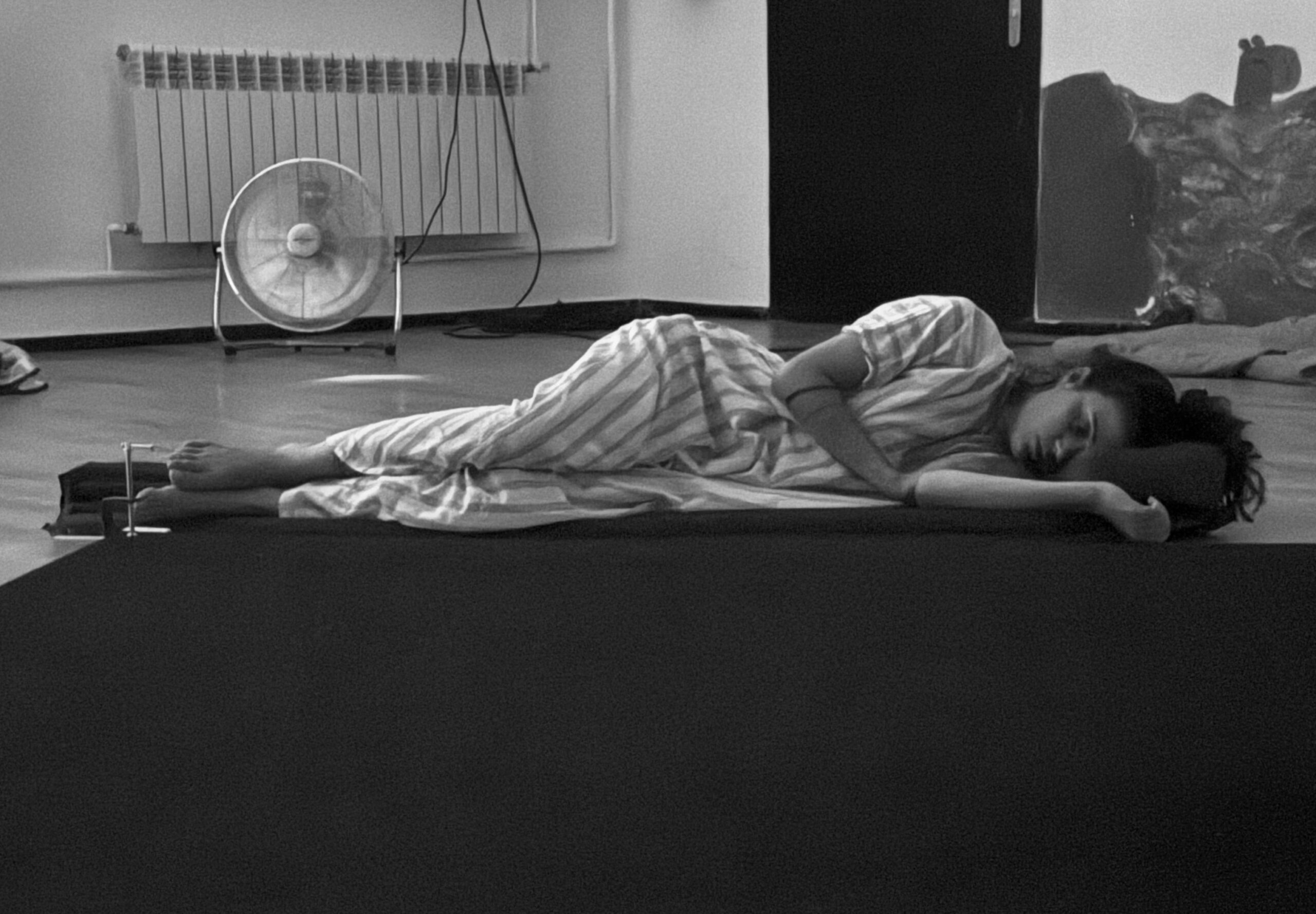
Alba Sauleda sleeping in her installation. Photo Marie Bruneau
The Labyrinths of the Maresme
We left on the 10th of August. Leaving the city on foot is not always easy. Around Barcelona, paths are destroyed and rebuilt every day by bicycles, motorbikes, walkers, and parked cars. That’s what suburbs are like: humans reshape the landscape daily. A recycled small table serves as a game table for a group of neighbors beside a highway. Under the bridge a fig tree grows, brave and wild. The children have taken refuge beneath a pile of tires: castle, ship, makeshift shelter. Someone is washing a car with the water that trickles through the improvised ditch of a vegetable garden enclosed by the metal frames of abandoned beds.
They name places, open streets, build viewpoints. They forbid access on private paths or even on public ones, and lay out gardens with benches for resting and fountains of chlorinated water that quench no one’s thirst but ours; in this heat, we have to drink litres and litres from any tap that still runs potable water. In the woods, the water from springs can no longer be drunk; and so it will be throughout our journey: all waters are contaminated. It is very hot, and drinking water, like walking, brings us closer to reality. Even if it tastes of chlorine, we fill our bottles.
Humans move mountains.
Walking the Maresme we have explored one of the most gentrified regions of Catalonia. An originally agricultural area, later one of the first to be colonised by tourists, and finally overtaken by the metropolitan expansion of Barcelona. To walk through industrial zones, housing estates and suburbs is to challenge the traditional idea of landscape — to break with the picturesque, and with many romantic notions about what deserves and what doesn’t deserve to be seen, what territories are worthy of being travelled.
At one of the first stops, the old school of Sant Pol, artist Alba Sauleda (who had been an artist-in-residence during the 2024 Grand Tour) presented her installation. It was based on the Dream’s Mailbox, and the constellations of freckles she created last year with the travellers. We talked with the audience, recounted our experience from the previous year, and saw what Alba had done with the material gathered between our skin and our dreams. We dined together in the installation itself, and then, one by one, we fell asleep around our own particular sky, which lies on the ground: the art piece is a Milky Way made of bodily constellations.
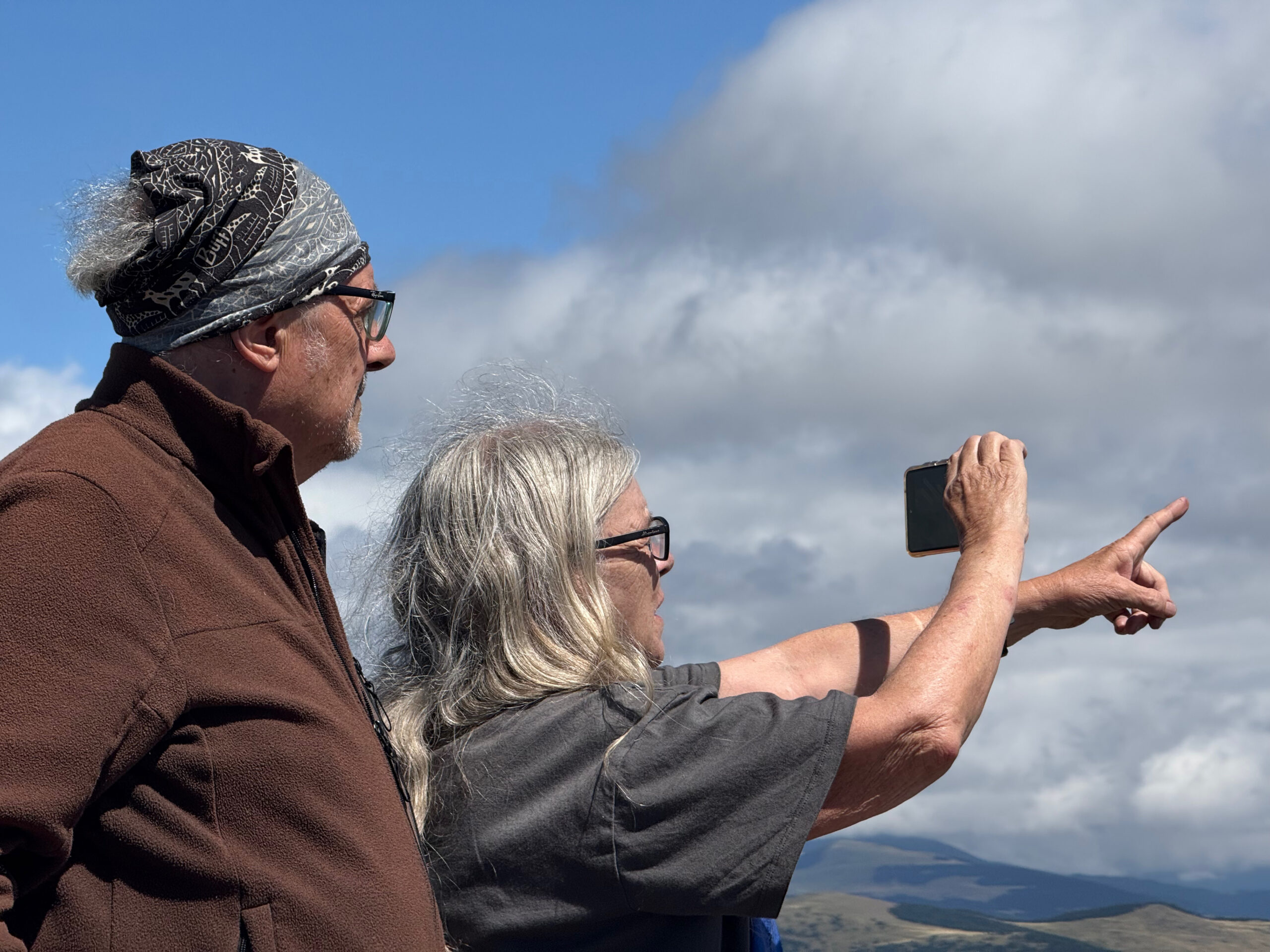
Clara and Salvador. Photo by Marie Bruneau
Campsites, Encampments, and Moving Cities
I remember two utterly different campsites along the Maresme. The first is one of the oldest campsites in Spain — and also one of those with the lowest ratings online. Proof of that how difficult it has become for many people to make a discovery if they are not, let’s say, comfortable. Few can tell an ash tree from a maple, or an old oak from a young linden; so when it comes to camping, it hardly matters whether the shade comes from a pruned mulberry or a plane tree.
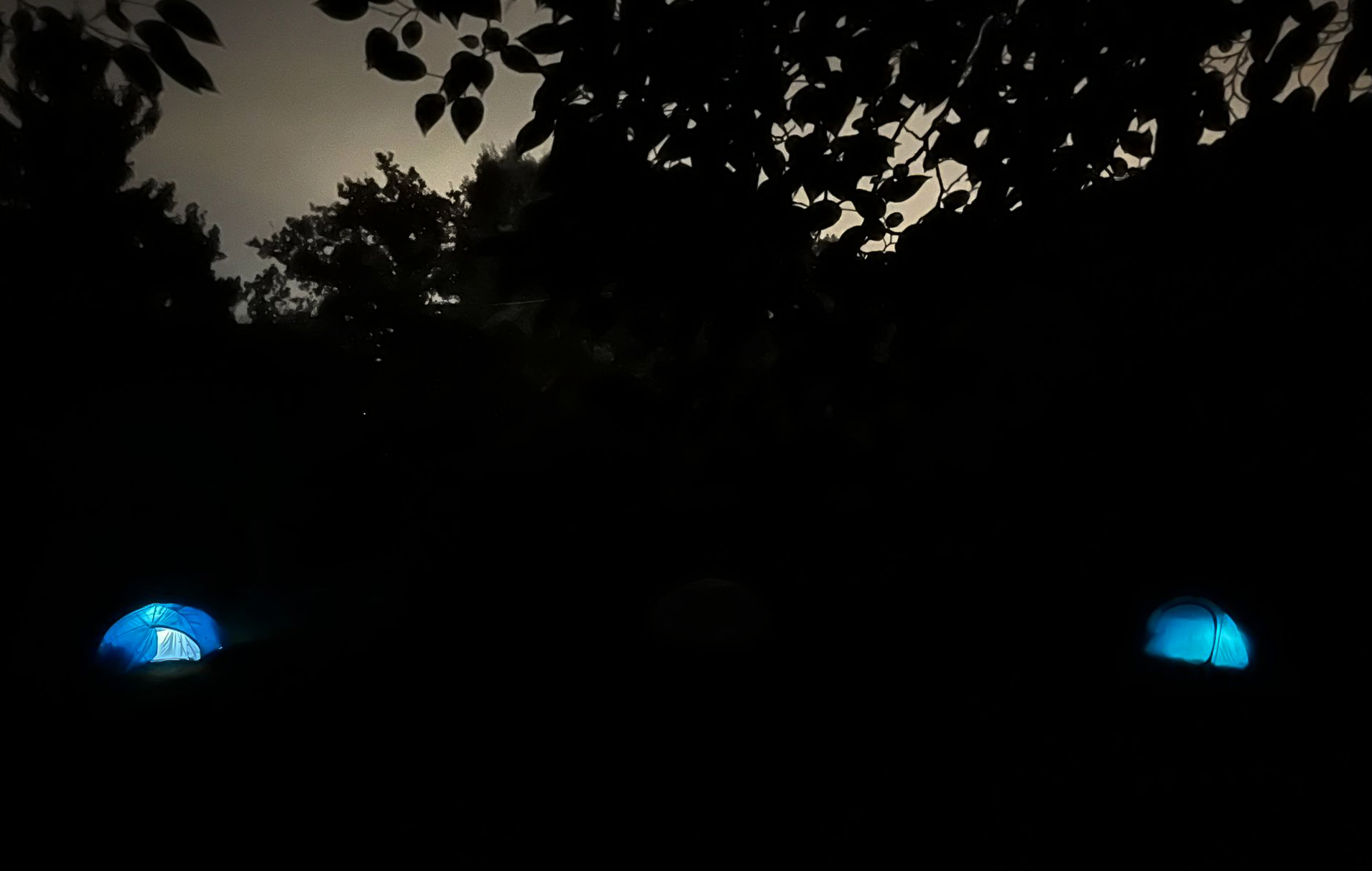
Run by two brothers, aged eighty and eighty-six respectively, it is one of those surprises life still gives you — marvels that some of us will never forget for one reason, and others will remember forever for quite the opposite. We camped in a section without electricity but with wide empty meadows, whispering poplars, silence and stars — the first ones of the journey.
The second campsite feels like a city — more Tijuana than Tyrolean meadow. A city made of tarps and awnings, porches, parasols and barbecues. A holiday city that shelters another one, tattooed on the bodies of its inhabitants. Dragons, tarot cards, garlands, hearts, princesses, arrows and parrots on the arms, legs, chests, ears and necks of our neighbours.
Our area is a small labyrinth of plots bordered by trimmed hedges, cosy enough. Amid the chaos there is a tacit order, written and unwritten rules that everyone knows and respects. In August, the Maresme feels like a vast campsite, crowded with people of every kind and origin, on the edge of a crisis of coexistence yet never quite crossing into it. I think of bees, of sheep, of sardines, of ants.
“Hey, are you the owner of the campsite?” A kid calls out to Jordi Rallo. He must have taken him for the boss. He asks whether the rule forbidding circulation inside the campsite after ten also applies to his small bicycle. No, Jordi is not the owner of the campsite. But the boy insists. “Can I?”
“What does the regulation say? That no one can circulate after ten, right? Then there you have it. You can’t.”
“See?” says his brother. “Told ya. No bikes after ten. Now get home.”
Towards the Blue Mountain
After our week by the sea we headed inland towards the Blue Mountain, as the Montseny is often called. It has only one river, the Tordera,
After our week by the sea we headed inland towards the Blue Mountain, as the Montseny is often called. It has only one river, the Tordera; not a long one, but the heart of the mountain is full of underground currents that bursts out in springs everywhere. We had to make our way through a torrent that recent rains had turned into a kind of jungle; we came out scratched all over. These things happen — they are the leap from the virtual to the real: there are maps, and there are territories.
Can Bonamic means ‘The House of Good Friends’. We are indeed good friends of this Art residency devoted to research and training in body and voice. It’s not the first time we’ve collaborated, and Neus Borrell has joined us on more than one Grand Tour. In the garden of a beautiful family farmhouse we pitch our tents for a couple of days. At night, an intimate concert with Neus Borrell, Bru Ferri and Maria Tharrats — a concert of polyphonies and traditional songs.
Higher up the mountain we reach Sant Marçal, in the heart of the Montseny, a historic landmark of Catalan mountaineering in the nineteenth and twentieth centuries. The hotel where we stay is like a bundle of rolled-up carpets stored in an attic: layers upon layers of memory, both remote and recent, illusions and versions of the same dream. It feels like being inside a Brothers Grimm tale. The rooms, the furniture, the lamps — all seem like portraits of themselves, not what they once were but still standing in for it.
If there are walls for so many engravings, maps, paintings and coats of arms, it is because of the narrowness of the windows and the breadth and thickness of the velvet curtains. Tonight we dream of great-grandmothers, of elves, and of talking crows.
The Pallarès Knife Society
Today two good friends join us, Pep and Sió: the kind who truly know how to travel. Seasoned van-lifers and strong walkers, always perfectly equipped and organised down to the last detail. With them, there’s never any need to worry. At lunchtime they unfailingly produce delicious sausages, handmade biscuits, and excellent chocolate.
Pep, like me, belongs to the Pallarès Knife Society. Not exactly a secret society: anyone can own a Pallarès; you can find them at markets and proper knife shops. But owning one is quite different from truly knowing what you hold in your hand: a matter of attitude, respect and affection towards an object that’s almost a sculpture; simple yet marvellous and functional.
Pallarès knives are made of iron, with forged blades that oxidise in sometimes capricious patterns. Knives that harbour bacteria and lichen, strange stains, traces of food and moss, wooden sticks whittled idly during moments of rest. They’re not the only good knives, far from it. Many walkers prefer the more sophisticated Opinel or Victorinox: more modern, cleaner, safer — in a word, “more contemporary.” But we stay loyal to this old folding knife made in Solsona.
Now the factory also make stainless-steel versions that cut far worse and, though clean, are as dull as anything that leaves no trace. Rumour has it that carbon-steel knives have been banned by the European Union; I don’t know if that’s true, but it is certainly harder to find an iron Pallarès knife these days, and they are ever more expensive.
In any case, Pep and I carry our Pallarès knives. We know this business with knives isn’t for everyone: many people find it hard to grasp why, sometimes, the worse is better.
From the Montseny to the Guilleries
We approach the village of Arbúcies. The river feels almost tropical; many of the plants invading its banks are not native, but descend from old bourgeois gardens — nineteenth-century colonial fantasies of shrubs, succulents and strange ferns, probably brought by timber merchants who travelled to the Americas and the East.
The humidity and fertility have produced a kind of wild nursery that fascinates us. On reaching our lodging we had a surprise: an old inn for traders, once where wagon wheels were exchanged for draft horses, now run by young, lively, sensitive people who have preserved their grandmothers’ memory while blending it with their business. Smiles everywhere, beers of every kind, colours on the dinner plates.
A few dream plants, a watering can, a wall clock, a pyramid filled with tiny Egyptian gods, and a half-broken goldfinch cage decorate the façades of the village, home to just seven people. The communal washhouse, wide and deep, dates from 1931; it still bears the numbers marking the washing spots. As we left the village, we saw a small book cabin: a library to rival our own, also devoted to bibliographic exchange.

GPS trail. Photo by Marie Bruneau
Sant Hilari, the town of springs
There was a time when Sant Hilari Sacalm was all springs, but today the water has been channelled and bottled to be distributed all over Spain. It’s the dance of waters: in Sant Hilari they drink water from Galicia, and in Murcia, water from San Sebastián. We drink waters that travel in plastic bottles, bouncing along the national roads from one end of the country to the other. We drink waters that have cost trucks, petrol, wages, roads, packaging, seals, pallets and advertising. It took us centuries to have drinking water in our homes — water straight from the tap — yet that joy has lasted barely fifty years: now we’re back to drinking bottled water, plastic water, from who knows where.
In Sant Hilari we are hosted by a singular collective. The artists of Excèntrica have occupied, for years, the rooms of a closed hotel: the Hostal Fugarolas, that once hosted traders, tourists and traffickers of all kinds. The association has an agreement with the owners and pays a reasonable rent for a building that would otherwise be squatted or in ruins.
Here, professional artists live alongside amateurs, self-taught ones, young and old. Each has arranged their room as they please: some as exhibition spaces, others as studios. The Excèntrics are warm hosts. We dine with them and talk about the town, the waters, art, and the road. We fall asleep across the hotel, drifting between bedrooms, reception and corridors.
The heart of the Guilleries, the deep forest region we walk through the following day, is emerald, juniper, the shadows of the deep fir forests. Once these were fierce places, pathless, dangerously wild, full of bandits and outlaws. Today they are woods and bird reserves, shelters of silence.
We cross them almost without meeting anyone, though every so often there is a surprise, such as a young runner with her beloved dog, or a New Zealand cyclist training for an elite race in Brazil. Along the way we pass huge felled trees; we stop to count their rings to see how old they were; some over a hundred years. We bathe in the torrent. Lying in the meadow under the tall trees, we are like chess pieces, pawns out of play.
How we went across La Plana and reached the Ripollès
In Roda de Ter lies another of our friendly spaces, Cardant Cultura: the former textile factory that no longer cards wool but has become a vibrant cultural and artistic project. There, beneath a vast linden tree, the trapeze poet Carla Farreny showed us a work in progress, Suspended Conversation: a physical suspension from a rope just twenty-five centimetres above the ground.
The delicate bodily balance links suspension with ecstasy, drawing on feminine mysticism and the art of waiting. The effort is the same as if the trapeze artist were flying ten metres up, but the risk is not physical: it is mental. After dinner, Rosa Cadafalch recited a long poem. Suspension, waiting and death intertwined under the starry night of the Plain, within the bodies and voices of Carla and Rosa.
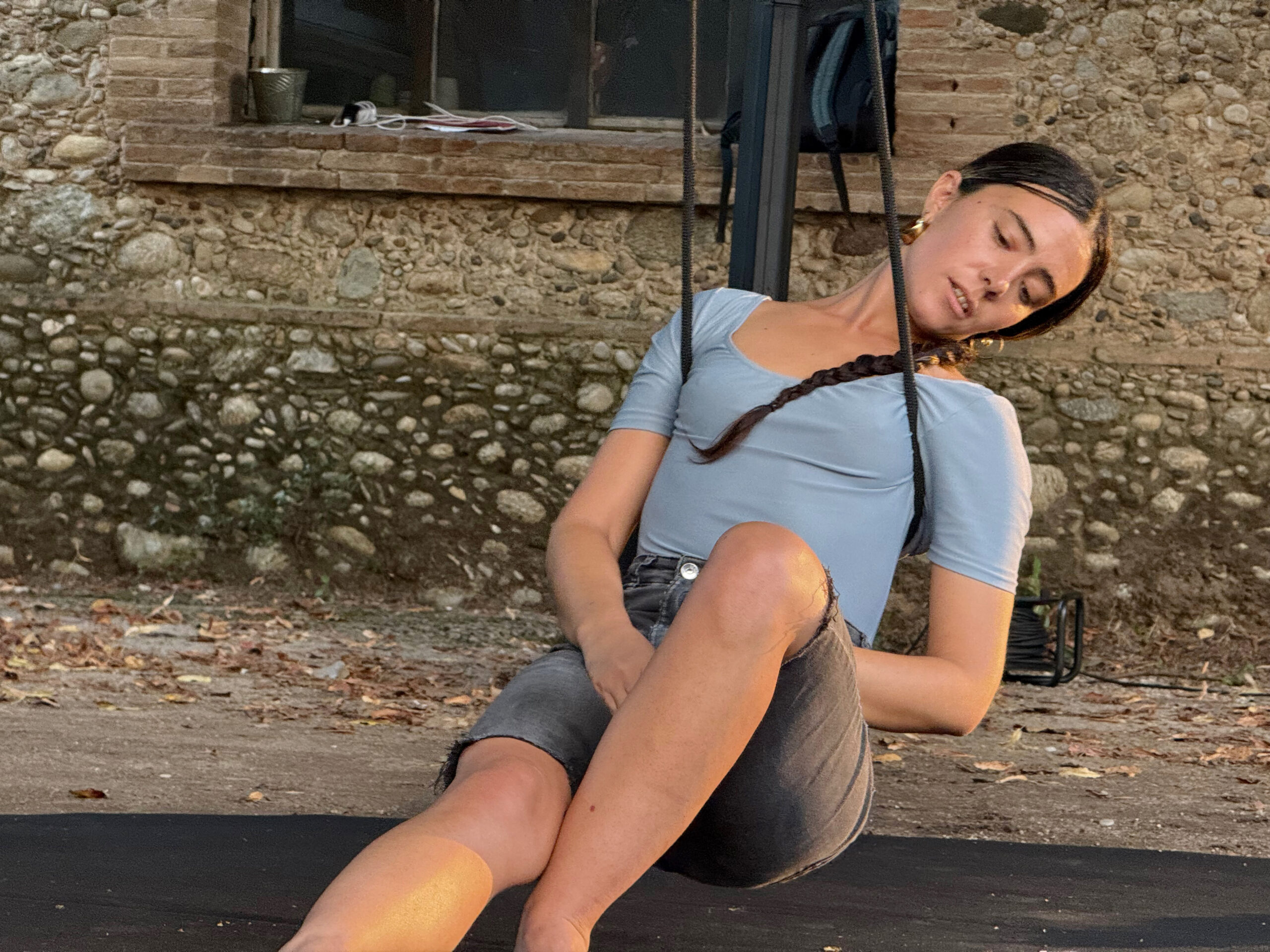
Carla Farreny, Suspended Conversation. Photo by Marie Bruneau
The next day we arrived at La Coma de Saderra, a secluded spot in the Bellmunt range, hosted by Mauna Association. For a couple of days, Salvador, Pau Giralt, Shanti Addagatla, the Sayari family and Michael Gadish immersed us in Indian culture: yoga, Rajasthani dance, stories from the Mahābhārata, South Indian cuisine.
Animals and Rains
We often talk at length about the animal life that surrounds us — and watches us. They look at us. The little fox has managed to outsmart our precautions, and the next morning we find the evidence: rummaged rubbish, scattered cooking utensils, some stolen object, useless to her, but perhaps attractive. Even though, walking in nature, we are better at being seen than at seeing, we discover each day that we are not alone. Thank you, Mauna. We leave the Serra de Bellmunt with our hearts full of life.
It rains in Vidrà; thunder rolls. Clothes are wet, tents too, and the van sinks into the mud. Like the children in the stories that storyteller Teresa Puig sometimes tells us at night, lost in the storm, we saw a small light in the woods and followed it. At La Plana Gran, Elena Cuesta opened for us the door of a beutiful wooden and glass domo. Her horses made room for us among the meadows.
With thunder and lightning, the storm warns us that summer is ending and that it’s time to get ready for the mushrooms. But we still have a few days left on the road.
The Power of the Object, at Mas Negre and the Taga
This is how we arrive at Mas Negre, a symbolic place on the slopes of the Serra Cavallera. Here we gather one last time to look back together at the road we’ve travelled, more than 300 kilometres. In the afternoon we close the cycle of the library and write ‘to be continued’ in our travel diaries.
We are here to take on a small challenge: to carry Frances Bartlett’s cello to the summit of the Taga — Frances is the musician who will play it once we reach the top — an ascent that will mark the culmination of our journey. Before that, we’ll take part in the ritual presentation of the book El poder del objeto. Materialidad, Memoria y Representación en la Baja Edad Media Europea, by Blanca Garí.
Throughout the journey, this book has served as a pretext for creative reflection on our relationship with the objects we move, those we carry with us, and the symbolic value we assign to them. It has also helped us to activate certain aspects of art that interest us in particular: small objects, boxes, fabrics, scents — everything that allows one to engage and become an active part of the artwork, ceasing to be a mere spectator.
Carrying objects, forming relationships with them, expressing the symbolic projection they radiate and taking part in their ritual and creative unfolding is central to the Grand Tour project, as Blanca reminds us. Even when we’re not aware of it, our daily relationship with objects breathes a symbolic dimension — one we now wish to bring to light as we end our journey.
We have reached this point with backpacks full of useful things — water and food — but also of other things: pebbles, bits of trunk, pressed flowers. Some were brought from home; others appeared along the way and have settled into our small boxes. Now we will place them on a symbolic “cloth of gold”, where they will rest beside rosemary — the plant of memory — and the light of a few candles.
‘More than possessing, we need to understand the deep mystery to which things point when we see them, when we hold them close, and when they look back at us. For they — the things — like us, the people, both form and belong to that great mystery that is vibrating matter. That great mystery which is, simply put, life itself.’
That’s how Blanca ended her reflection, followed by several songs and melodies played by Frances Bartlett on the cello, accompanied by Jordi Rallo on percussion. At the close of the ceremony, each walker took a blue shawl to wear the next day for the ascent to the Taga.
Early the next morning, twenty-five people, each wearing a blue shawl, took turns carrying the cello covered with a golden cloth. At the top of the Taga (2,040 m), Frances played and sang to the universe. She was there for her music, but also through the strength — physical and moral — of all of us; and it was in that moment that our community of walkers became, itself, the music.
It was the end of an unforgettable journey. The day we carried, together, a cello to the skies.
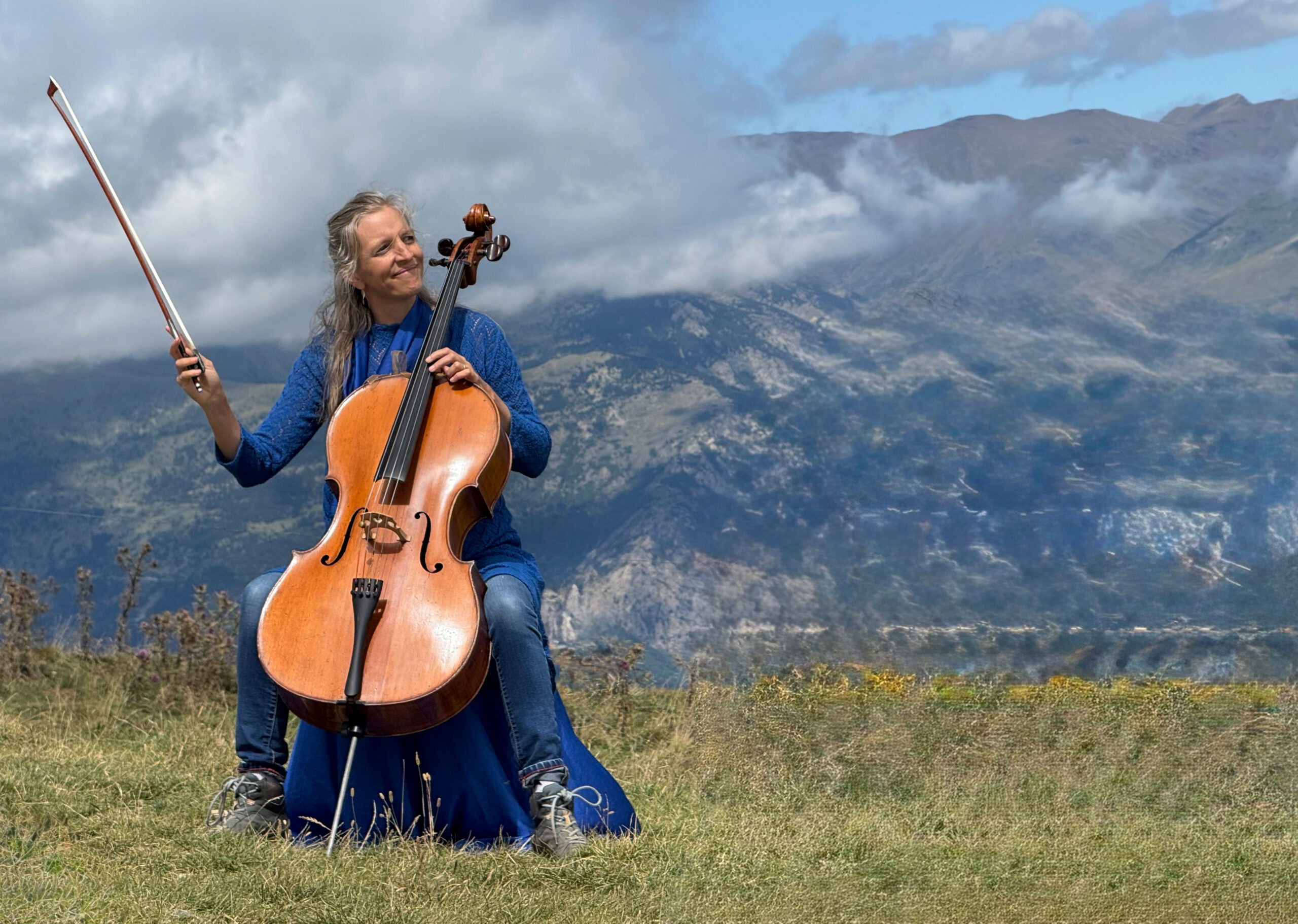
Cello in Taga, Frances Bartlett. Photo by Marie Bruneau
Recent articles
In summer 2025, for one entire week, walking became the defining activity in Prespa, a mountainous transboundary landscape where two ancient freshwater lakes traverse Greece, Albania, and North Macedonia. Through acts of healing, experiencing, resisting and becoming, WAC 25 explored walking as a multifaceted practice as part of the wider,… Read more »

More than just a large male marble face near the heart of Rome, the Bocca della Verità is above all a medieval legend about the existence of a statue that would bite the hand of anyone who lied while placing it inside. This 1891 text was written by Ersilia Caetani… Read more »

With thousands of miles of stone walls and remnants of prehistoric settlements, the three Aran Islands in Galway Bay, Western Ireland, recently served as the setting for a short film essay entitled Aran Diary (2023) by researcher and filmmaker Maurizio Cinquegrani. This piece shares glimpses of the walks and ideas… Read more »